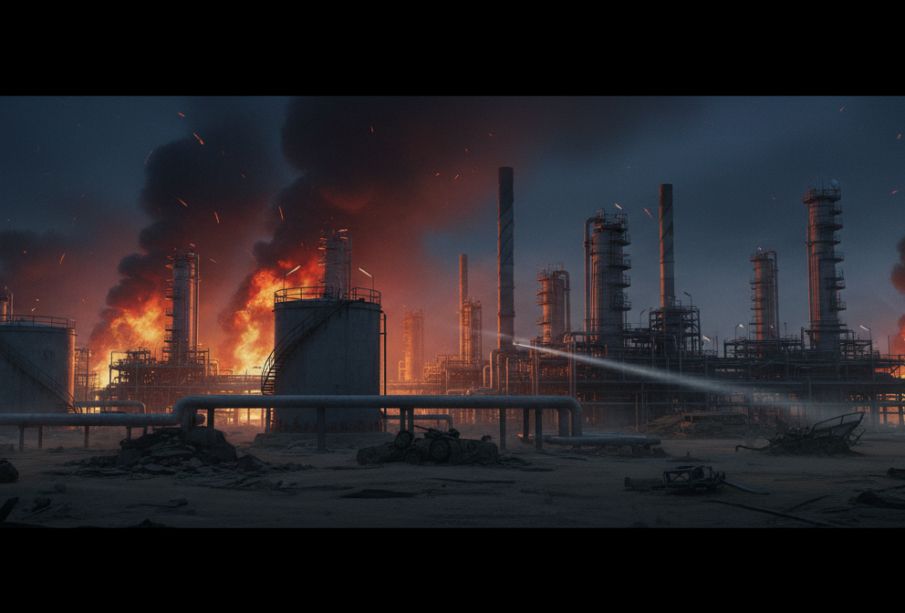
President Trump claims the US-Israel operation against Iran is nearing completion while oil prices hit their highest levels since 2022, creating economic shockwaves worldwide.
The Middle East is burning, and your gas tank is feeling it. Oil prices rocketed past $100 a barrel on Monday for the first time since Russia invaded Ukraine, as President Trump‘s war with Iran enters its second week with no clear end in sight.
Speaking from his Doral resort in Florida, Trump struck an oddly optimistic tone despite the chaos unfolding across the region. ‘We’re achieving major strides toward completing our military objective,’ he declared, adding that some people could say they’re ‘pretty well complete.’ When pressed about timing, he promised the operation would end ‘very soon’ – though he wouldn’t commit to this week.
But the numbers tell a different story. Global oil prices have surged more than 25% since the conflict began on February 28, with Brent crude briefly touching $120 a barrel before settling around $104. American drivers are already feeling the pinch, with regular gasoline jumping from around $3 per gallon to $3.45 nationwide, according to AAA. That’s a 43-cent spike in just one week.
The economic pain is spreading far beyond American gas stations. Stock markets across Asia plummeted Monday morning, with Japan‘s Nikkei falling over 5% and South Korea‘s KOSPI dropping 6%. European markets opened sharply lower as investors braced for what energy analysts are calling a ‘game-changing and unprecedented’ crisis.
At the heart of the chaos lies the Strait of Hormuz, the narrow waterway through which 20% of the world’s oil normally flows. Iran‘s Revolutionary Guard has effectively shut down shipping through the strait, with transit numbers plummeting 95% in the first week of March. Just 55 ships made the passage compared to 160 the week before, according to S&P Global Market Intelligence.
The conflict has already claimed American lives, with seven US service members confirmed killed in combat. Iran‘s Supreme Leader Ali Khamenei was killed in the initial strikes, replaced by his hardline son Mojtaba Khamenei – a move Trump called ‘unacceptable.’
Meanwhile, the war has spilled dramatically into Lebanon, where Hezbollah fighters are battling Israeli forces in multiple locations. On Monday, the Iran-backed group reported engaging approximately 15 Israeli helicopters that landed in eastern Lebanon near the town of Nabi Sheet. Two Hezbollah officials claimed they shot down an Israeli helicopter, though Israel‘s military hasn’t commented.
This marks the second such helicopter operation in the area. Last Friday, Israeli commandos conducted a failed raid searching for the remains of Ron Arad, an airman missing since 1986. That operation left 41 people dead, including three Lebanese soldiers.
The human cost in Lebanon is mounting rapidly. Health Minister Rakan Nassereddine reported 394 people killed in Israeli strikes over the past week, including 83 children and 42 women. More than half a million Lebanese have been displaced, with over 117,000 now in government shelters.
Energy markets are in full panic mode. Iran has targeted refineries and gas facilities across the Gulf, forcing Qatar to declare force majeure on its massive gas exports. Kuwait, Iraq, and the UAE have all cut oil production because there’s literally nowhere to store the crude they’re pumping.
Trump tried to downplay the economic impact, posting on Truth Social that rising oil prices are ‘a very small price to pay for U.S.A., and World, Safety and Peace.’ He added: ‘ONLY FOOLS WOULD THINK DIFFERENTLY!’ But with analysts warning prices could hit $150 or even $200 per barrel if the Strait of Hormuz remains closed, that ‘small price’ could become a massive economic headache.
The administration is scrambling to contain the damage. The Treasury Department issued a 30-day sanctions waiver allowing India to buy more Russian oil, while the International Development Finance Corp is offering political risk insurance for tankers. Trump has floated naval escorts for ships, though no concrete plan has emerged.
For now, the world watches and waits as oil prices swing wildly and the conflict shows no signs of cooling down. Trump‘s promise of a quick victory feels increasingly hollow as the war’s economic shockwaves ripple across the globe, hitting American wallets and threatening to derail the global economy just as it was finding its footing again.




We bring you daily news from around the world. From technology to lifestyle to design and music.