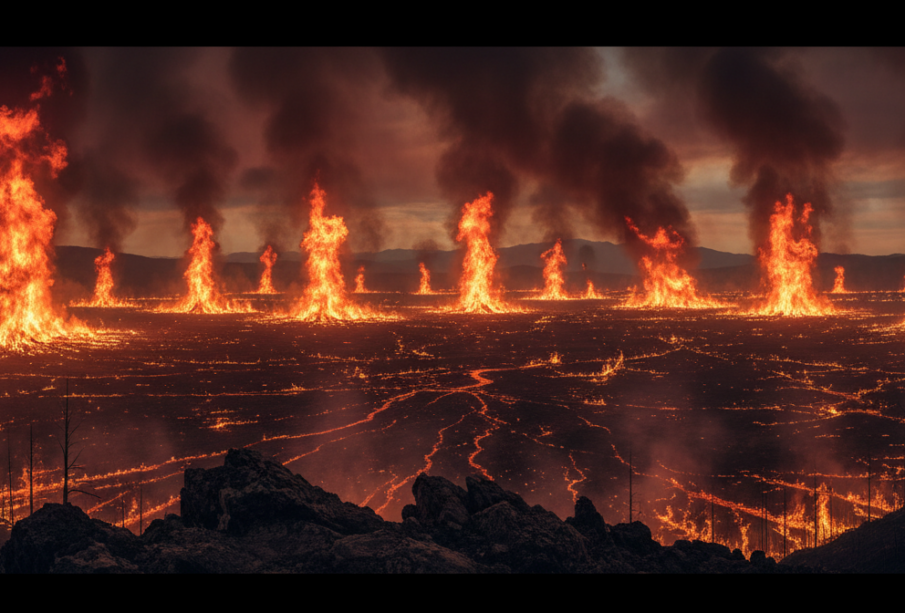
A new study reveals that dangerous fire weather conditions now occur simultaneously across the globe nearly three times more often than 45 years ago, straining international firefighting resources as countries can no longer rely on neighbors for help.
The New Reality of Synchronized Flames
The numbers tell a stark story. In the early 1980s, the world experienced about 22 days per year when multiple regions faced the hot, dry, windy conditions that make wildfires nearly unstoppable. By 2023 and 2024, that figure had jumped to more than 60 days annually – a nearly threefold increase that’s reshaping how we think about global fire management.
This isn’t just about more fires in more places. It’s about the dangerous convergence of fire seasons that once occurred at different times of the year, allowing countries to share firefighting resources. Cong Yin, a fire researcher at UC Merced who led the study published in Science Advances, puts it simply: ‘When extreme fire weather happens in many places at once, it increases the likelihood of widespread fire outbreaks and strains firefighting capacity.’
The Americas Bear the Heaviest Burden
While the global trend is alarming, the Americas are experiencing the most dramatic changes. The continental United States saw its fire-prone weather days increase from an average of 7.7 days per year in the 1980s to 38 days in the last decade.
But those numbers pale compared to southern South America. This region has witnessed an explosion from 5.5 synchronous fire weather days annually in the late 1970s to more than 70 days in recent years. In 2023 alone, the region experienced 118 such days – meaning dangerous fire conditions existed simultaneously across multiple countries for nearly one-third of the year.
Having covered environmental stories across Latin America for years, I’ve seen firsthand how these overlapping fire seasons are overwhelming local resources. Countries that once could count on international assistance now find their potential helpers battling their own blazes.
The Climate Connection
The study’s most sobering finding may be its attribution analysis. Using computer simulations, Yin and his colleagues compared our current reality with a hypothetical world without increased greenhouse gases from burning fossil fuels. Their conclusion: more than 60% of the increase in synchronized fire weather can be directly attributed to human-caused climate change.
‘These sorts of changes that we have seen increase the likelihood in a lot of areas that there will be fires that are going to be very challenging to suppress,’ explains John Abatzoglou, a fire scientist at UC Merced and co-author of the study. When I ask researchers about tipping points in climate science, this kind of systematic breakdown in international cooperation represents exactly the sort of cascade effect that keeps them awake at night.
Breaking Point for Global Cooperation
The implications extend far beyond weather statistics. For decades, countries like the US, Canada, Australia, and several European nations have maintained mutual aid agreements for firefighting. When California burns, Australian crews might fly in to help. When Canada faces extreme fire seasons, American resources cross the border.
But this system depends on fires happening at different times in different places. ‘That’s where things begin to break,’ Abatzoglou warns. The study found that of 14 global regions analyzed, only Southeast Asia showed a decrease in synchronous fire weather – likely because the region is becoming more humid.
The research focused purely on weather conditions rather than actual fires, examining the combination of heat, dryness, and wind that creates the perfect storm for wildfire ignition and spread. While weather is just one factor – fires also need fuel like vegetation and an ignition source – it’s often the determining factor in whether a small fire becomes a catastrophic blaze.
A World on Fire
This study arrives as 2024 set new records for global forest fires, with at least 13.5 million hectares burned worldwide – an area roughly the size of Greece. The year marked the first time major fires raged simultaneously across both tropical and boreal forests, with Brazil, Bolivia, Russia, and Canada all experiencing some of their worst fire seasons since satellite monitoring began.
As someone who has reported from fire zones across three continents, I’ve watched this transformation unfold in real time. The old rhythms of fire seasons – predictable patterns that allowed for resource sharing and recovery periods – are giving way to a new reality where the entire world seems perpetually at risk.
The message from this research is clear: we’re entering an era where the luxury of mutual aid in firefighting may become increasingly rare, just when we need it most.






We bring you daily news from around the world. From technology to lifestyle to design and music.