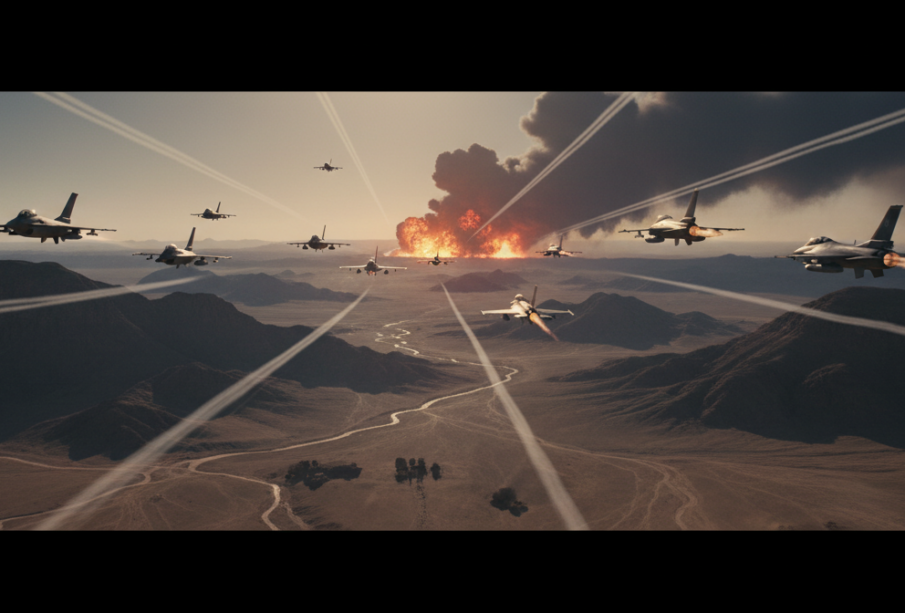
The U.S. and Israel have launched their biggest military operation since Iraq 2003, killing Iran’s supreme leader and sparking a regional conflict that could reshape the Middle East forever.
The Hour of Freedom
At 2:30 AM on February 28, Trump didn’t address the nation from the Oval Office. Instead, he posted an eight-minute video on Truth Social announcing ‘major combat operations in Iran.’ By Saturday afternoon, he was confirming what seemed impossible just hours earlier: Ayatollah Ali Khamenei, Iran’s supreme leader for nearly four decades, was dead.
‘The hour of your freedom is at hand,’ Trump told the Iranian people in his pre-dawn message. ‘When we are finished, take over your government, it will be yours to take. This will be probably your only chance for generations.’
The joint U.S.-Israeli operation, codenamed ‘Epic Fury’ by the Pentagon and ‘Roaring Lion’ by Israel, represents the largest American military buildup in the Middle East since the 2003 invasion of Iraq. For weeks, while diplomats held nuclear talks in Geneva, Trump was quietly assembling a massive fleet of fighter jets and warships in the region.
Tehran Burns
The strikes hit multiple targets across Iran, from the capital Tehran to cities like Kermanshah, Qom, and Isfahan. Videos shared on social media showed smoke billowing from several parts of Tehran, including near the offices of the now-dead supreme leader.
The most devastating blow came at an elementary school in Minab, where an Israeli strike killed at least 148 students according to Iranian state media. Iran’s Foreign Ministry spokesman told NPR that ‘some of them are still under the rubble.’
But Iran isn’t going down quietly. Tehran launched unprecedented retaliatory strikes across the Middle East, targeting U.S. military bases in Bahrain, the United Arab Emirates, Qatar, Kuwait, and Saudi Arabia. In Dubai, dramatic footage showed people fleeing smoke-filled passageways at the international airport, while the luxury Fairmont Hotel sustained visible damage with flames punching through its exterior wall.
American Blood
By Sunday, the war’s toll was becoming clear. Three U.S. service members were confirmed dead, marking the first American casualties since the operation began. Trump grimly warned there would ‘likely be more.’
In Israel, at least nine people died in an Iranian missile attack near Jerusalem. The conflict is spreading faster than anyone anticipated, with French President Emmanuel Macron warning of ‘grave consequences for international peace and security.’
Trump responded to Iran’s retaliation with characteristic bluster, threatening to respond with ‘a force that has never been seen before’ if Tehran escalated further. He also claimed U.S. forces had sunk nine Iranian naval ships and ‘largely destroyed’ Iran’s naval headquarters, though U.S. Central Command wouldn’t confirm these claims.
The Gamble
This isn’t just another Middle East conflict—it’s a massive gamble on regime change. Both Trump and Israeli Prime Minister Netanyahu are betting that the Iranian people will rise up and overthrow their government. It’s a strategy that foreign policy experts are calling ‘wholly untested.’
The timing is particularly striking. Just two weeks of nuclear negotiations had reportedly made progress, with Iran agreeing to zero uranium stockpiling and full international verification. Critics argue Trump used diplomacy as a ‘cover operation’ before launching the bombs.
For Netanyahu, facing elections in October and trailing in polls, the return to war might be seen as a chance to shore up domestic support. The Israeli leader has repeatedly said Iran must never be allowed to acquire nuclear weapons, despite Iran’s public commitments that it has no intention of building a bomb.
Global Shockwaves
The international response has split predictably along geopolitical lines. European leaders largely back the operation, with EU Commission President Ursula von der Leyen calling for a ‘credible transition’ in Iran. Australia’s Prime Minister called Iran a ‘destabilizing force for decades.’
But China and Russia are furious. Chinese Foreign Minister Wang Yi called the attacks ‘unacceptable,’ while Russian Security Council Deputy Chairman Dmitry Medvedev accused Washington of using negotiations as a cover for war.
Oil prices have surged on fears of supply disruptions, while global stock markets pulled back. Trump told the Daily Mail the conflict could last ‘four weeks or so,’ but with Iran’s leadership in chaos and retaliatory strikes spreading across the region, nobody really knows where this ends.
What’s clear is that the Middle East will never be the same. Whether Trump’s gamble on Iranian regime change pays off—or backfires spectacularly—could define his presidency and reshape the global order for generations to come.

Leave a reply



We bring you daily news from around the world. From technology to lifestyle to design and music.