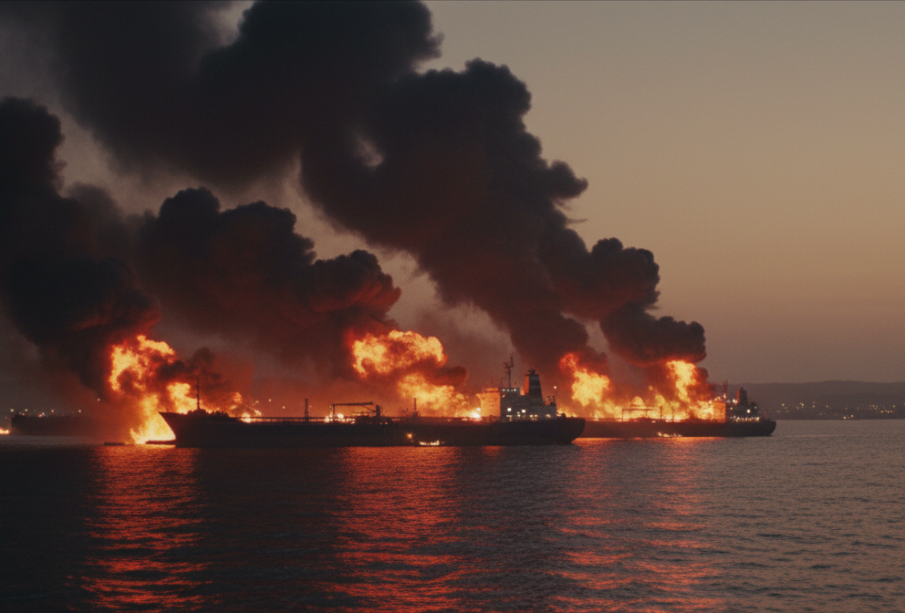
Two oil tankers erupted in flames near Iraq’s Basra port after Iranian explosive boats struck them Wednesday, killing an Indian crew member and escalating the Middle East conflict.
Death in the Water
The flames spread across the water like a deadly orange carpet, fed by thousands of barrels of crude oil spilling from two burning tankers. What started as another day of ship-to-ship transfers near Basra’s port turned into a nightmare when Iranian explosive boats struck the vessels Wednesday morning.
An Indian sailor aboard the US-owned Safesea Vishnu lost his life in the attack. The remaining 15 Indian crew members were evacuated to safety, along with 23 others from the second vessel, the Malta-flagged Zefyros. The tankers, carrying an estimated 400,000 barrels of Iraqi oil worth roughly $30 million, were anchored side by side when the attack began.
Explosive Boats and Burning Oil
According to Iraqi investigators, explosive-laden Iranian boats rammed into both tankers in what officials called a ‘flagrant violation’ of Iraq’s sovereignty. The attack occurred within Iraqi territorial waters at the Al Faw port, about 30 miles southeast of Basra.
Footage verified by maritime security firms shows the massive vessels engulfed in flames, with oil spreading across the surrounding water. The Safesea Vishnu, a 74,000-ton crude carrier flying under the Marshall Islands flag, suffered the worst damage. Its sister ship, the 50,000-ton Zefyros, also caught fire after the coordinated assault.
This marks the first time Iran has directly targeted oil infrastructure in Iraqi waters since the conflict began February 28, when President Trump and Israel launched Operation Epic Fury against Iranian targets.
The Strait Stranglehold
The tanker attacks represent just the latest escalation in Iran’s campaign to choke off global oil supplies. Since the war began, Iranian forces have effectively closed the Strait of Hormuz, the narrow waterway through which roughly 20% of the world’s oil normally flows.
Ayatollah Mojtaba Khamenei, Iran’s new Supreme Leader following his father’s death in an Israeli strike, vowed to keep the strait closed as a ‘tool of pressure.’ Iranian officials warned oil prices could hit $200 per barrel – nearly double current levels of around $105.
Shipping traffic through the strait has virtually ground to a halt. Only five oil tankers have left the Persian Gulf in the past day, while about 500 remain trapped in the region. Many vessels have turned off their tracking systems or falsely broadcast Indian crew information, hoping to avoid Iranian attacks.
Global Energy Crisis
The attacks have triggered what the International Energy Agency calls the ‘largest supply disruption in the history of the global oil market.’ Gulf states’ total oil output has dropped by at least 10 million barrels per day, surpassing even the disruptions of the 1970s oil embargo.
In response, the IEA announced its 32 member countries will release a record 400 million barrels from emergency reserves. The US alone plans to tap 172 million barrels from its Strategic Petroleum Reserve. President Trump has also offered discounted shipping insurance for vessels attempting to transit the strait, though few captains are willing to risk the journey.
The crisis extends beyond oil. Natural gas prices in Europe have nearly doubled, jumping from €30 per megawatt-hour to over €60. Major shipping companies have suspended operations in the Gulf, and cruise lines have stranded 15,000 passengers on six ships unable to transit the strait safely.
No End in Sight
As flames continued to burn from the attacked tankers Thursday, Iran launched fresh missile and drone strikes across the region. The UAE, Kuwait, and Saudi Arabia all reported intercepting Iranian projectiles, while three more ships were struck overnight in separate incidents.
The escalating maritime warfare shows no signs of slowing. Iran has deployed naval mines throughout the strait, prompting US forces to destroy 16 Iranian minelaying vessels this week. Meanwhile, shipping costs have skyrocketed, with war-risk insurance premiums jumping from 0.125% to as much as 0.4% of a ship’s value per transit – adding a quarter-million dollars in costs for large tankers.
For the families of the Indian sailor killed aboard the Safesea Vishnu, the global energy crisis has a deeply personal cost. As one maritime analyst noted, with Indians comprising over 15% of the world’s seafarers, there’s likely to be more ‘collateral damage’ as this conflict continues to rage across the world’s most vital shipping lanes.



Leave a reply



We bring you daily news from around the world. From technology to lifestyle to design and music.