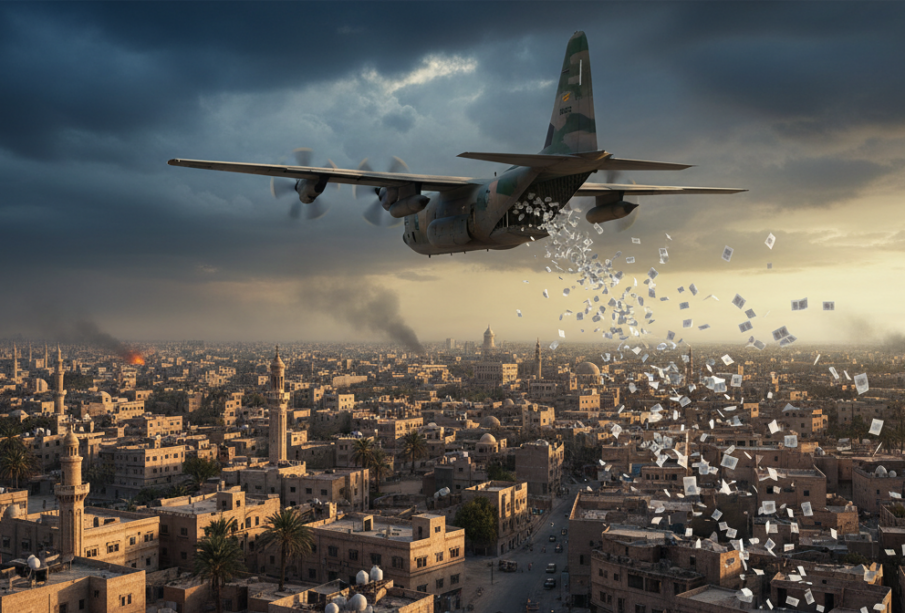
President Trump escalates threats against Iran while Israeli forces drop propaganda leaflets over Beirut, as the 13-day conflict shows no signs of ending despite massive destruction.
War Rhetoric Intensifies
President Trump delivered his starkest warning yet to Iran on Friday, promising the regime would be hit ‘very hard’ in the coming days as the US-Israeli military campaign enters its third week. Speaking on the Brian Kilmeade Show, Trump boasted that American forces had destroyed nearly 90% of Iran’s missile arsenal and were ‘hitting them harder than anybody’s been hit since World War II.’
The president’s escalating rhetoric comes as oil prices have soared past $100 per barrel due to Iran’s effective blockade of the Strait of Hormuz, through which roughly one-fifth of global oil production flows. Gas prices in the US have jumped to $3.32 per gallon, adding economic pressure to the military campaign that began February 28.
‘We’ve already damaged them so badly it would take years for them to ever rebuild,’ Trump declared, adding that pressure on Iran would increase significantly this week. The comments followed mixed signals from the president about whether the war was nearing its end, despite earlier claims of being ‘ahead of schedule.’
Psychological Warfare Over Beirut
As Trump ramped up his threats, Israeli warplanes conducted a dramatic propaganda operation over Beirut, dropping thousands of leaflets across the Lebanese capital. The sonic booms from low-flying aircraft terrified residents, who initially feared they were under attack.
The leaflets, bearing messages in Arabic, urged Lebanese citizens to ‘disarm Hezbollah, Iran’s shield’ and declared that ‘Lebanon is your decision, not someone else’s.’ Some pamphlets included QR codes linked to Unit 504, an Israeli intelligence unit specializing in human recruitment.
Lebanese authorities quickly warned citizens not to scan the codes, with the army cautioning they could connect people to Israeli intelligence services. One Beirut resident, Ali Chedid, who was displaced from southern Lebanon, described hearing ‘a boom sound, like a strike, and suddenly we saw the leaflets.’ He dismissed the messages as ‘gibberish,’ while another local vowed that ‘no matter what they do we’re going to stay and resist.’
Expanding Conflict Zone
The leaflet drop coincided with UN Secretary-General Antonio Guterres’ arrival in Beirut for what he called a ‘solidarity visit.’ Guterres appealed to both Israel and Hezbollah to ‘stop the war,’ emphasizing that Lebanese people ‘did not choose this war’ but were ‘dragged into it.’
Israeli strikes have killed at least 773 people in Lebanon since March 2, including 103 children, according to the Lebanese Ministry of Public Health. More than 800,000 people – roughly one in seven of Lebanon’s population – have been forced from their homes. The conflict expanded dramatically when Israel struck the Zrarieh Bridge over the Litani River, marking the first acknowledged attack on civilian infrastructure.
Defense Minister Israel Katz warned of escalating damage to Lebanese infrastructure, stating that the government would face ‘increasing costs through damage to infrastructure and loss of territory’ as long as Hezbollah remained armed.
Iran Digs In for Long Fight
Despite the massive bombardment, Iran shows little sign of capitulation. The regime has installed Mojtaba Khamenei, son of the assassinated Supreme Leader Ali Khamenei, as the new leader – a choice Trump called disappointing. The younger Khamenei has vowed to keep the Strait of Hormuz closed until the war ends.
Iranian officials have rejected Trump’s demands for ‘unconditional surrender,’ with Revolutionary Guard spokesperson Ali Mohammad Naini declaring that ‘Iran will determine when the war ends.’ Foreign Minister Abbas Araghchi ruled out negotiations, citing America’s history of attacking during diplomatic talks.
The human cost continues mounting, with over 1,300 killed in Iran and 570 in Lebanon, while 12 Israelis have died. Yet Iran’s ability to maintain the Hormuz blockade and continue launching drone attacks suggests the regime’s survival strategy may be working. As one CNN analysis noted, Iran’s path to victory is simple: ‘It just has to survive.’
Economic Shockwaves
The conflict’s economic impact extends far beyond the Middle East. Oil disruptions have forced major producers like Saudi Arabia to suspend refinery operations, while Iraq has shut down some production facilities. Countries including Bahrain, Kuwait, Qatar, and the UAE report strikes on their oil infrastructure.
Stock markets worldwide have tumbled as inflation fears resurge. India, heavily dependent on Persian Gulf crude, faces particular vulnerability, prompting the US Treasury to issue a 30-day waiver allowing Indian refineries to purchase Russian oil previously under sanctions.
Trump has threatened to hit Iran ‘twenty times harder’ if it continues blocking oil shipments, while promising to escort commercial vessels through Hormuz if necessary. However, Iranian military officials have said they would ‘welcome’ such moves, suggesting they’re prepared to engage US naval forces directly in the strategic waterway.




We bring you daily news from around the world. From technology to lifestyle to design and music.