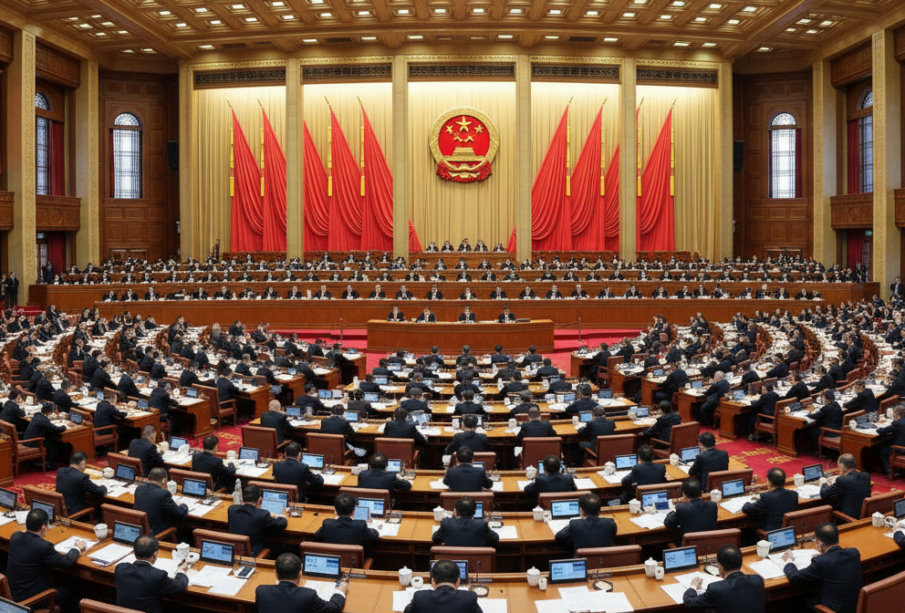
China’s rubber-stamp parliament has approved sweeping ethnic unity legislation that critics say will further erode minority rights while cementing Beijing’s push toward cultural assimilation.
The Vote That Surprised No One
The numbers tell the story of China’s political theater. Over 2,760 delegates to the National People’s Congress voted Thursday to pass the Promoting Ethnic Unity and Progress law, with just three opposing it and three more abstaining. It’s the kind of near-unanimous result that would make any democratic legislature blush, but for China’s rubber-stamp parliament, it’s just another Thursday.
The NPC, which hasn’t rejected a single item on its agenda in decades, wrapped up its annual session with this vote alongside approving the country’s historically low GDP growth target of 4.5 to 5 percent for 2026. That economic figure, the lowest in decades, reflects Beijing’s shifting priorities as much as its challenging domestic situation. But it’s the ethnic unity law that carries the more profound implications for China’s 125 million ethnic minorities.
Mandarin as the Great Unifier
The new law codifies what President Xi Jinping has long championed: the ‘sinicization’ of China’s ethnic minorities. Think of it as cultural homogenization with Chinese characteristics. The legislation requires schools to use Mandarin by default, effectively sidelining minority languages like Tibetan, Uyghur, and Mongolian from primary educational roles.
This isn’t just about language instruction. The law mandates that Mandarin be displayed more prominently than minority scripts on public signage, and requires preschoolers to become proficient in Mandarin before they can barely tie their shoes. It’s a comprehensive approach that would make any efficiency expert proud, if the goal were erasing cultural diversity.
The policy has already shown its teeth in places like Inner Mongolia, where 2020 protests over language erosion led to arrests and re-education campaigns. Reports suggest public signs there have already been renovated to show Mandarin characters more prominently than Mongolian script.
Xi’s Vision of Pomegranate Seeds
Xi has famously said that China’s ethnic groups should be like ‘pomegranate seeds that stick together.’ It’s a poetic metaphor for what critics call forced assimilation. The law embeds Xi’s vision of ‘fostering a strong sense of community for the Chinese nation’ into the country’s legal framework, making it not just policy but law.
According to NPC Observer, a website tracking Chinese politics, this legislation received unusual attention from the Communist Party’s full politburo in 2025 – something not reported in four decades. When the party’s top brass spends that much time on a draft law, you know it’s more than bureaucratic housekeeping.
Yalkun Uluyol from Human Rights Watch didn’t mince words: ‘Many of the policy directives proposed in the new law already exist in practice in Xinjiang, Tibet, or Inner Mongolia.’ He called it ‘a blatant move by Beijing to legalise forced assimilation and political control.’
The Numbers Game
The law affects over 125 million minorities across China’s vast territory. In Xinjiang, Uyghurs make up 46 percent of the local population. In Tibet, Tibetans represent 90 percent. Inner Mongolia has Mongolians at 17 percent, while Guangxi sees the Zhuang people at 32 percent.
These aren’t small communities we’re talking about. The combined GDP of China’s five autonomous regions grew at an average annual rate of 5.6 percent from 2020 to 2024, outpacing the national average. Economic development has been Beijing’s carrot alongside the stick of cultural assimilation.
The law also creates legal grounds for prosecuting people or organizations outside China if their actions harm ‘ethnic unity’ – echoing the extraterritorial reach of the National Security Law imposed on Hong Kong in 2020. It’s a reminder that Beijing’s legal reach now extends far beyond its borders.
Beyond Language: The Bigger Picture
This legislation comes as China announced its lowest GDP growth target in decades, signaling a shift from breakneck expansion to what officials call ‘high-quality development.’ The 4.5 to 5 percent target for 2026, down from previous targets of ‘around 5 percent,’ reflects economic headwinds but also changing priorities.
The ethnic unity law fits into this broader narrative of consolidation and control. As China’s economy matures and growth slows, the party appears more focused on ensuring social stability and ideological conformity. The law tasks everyone from government bodies to private enterprises, including local governments and mass organizations, with promoting ethnic unity.
Rayhan Asat, a legal scholar at Harvard, whose brother is serving a 15-year prison sentence in Xinjiang on charges of inciting ethnic discrimination, put it bluntly: ‘The law serves as a strategic tool and gives the pretext to government to commit all sorts of human rights violations.’ For China’s ethnic minorities, the pomegranate seeds metaphor might feel more like being crushed together than sticking together by choice.







We bring you daily news from around the world. From technology to lifestyle to design and music.