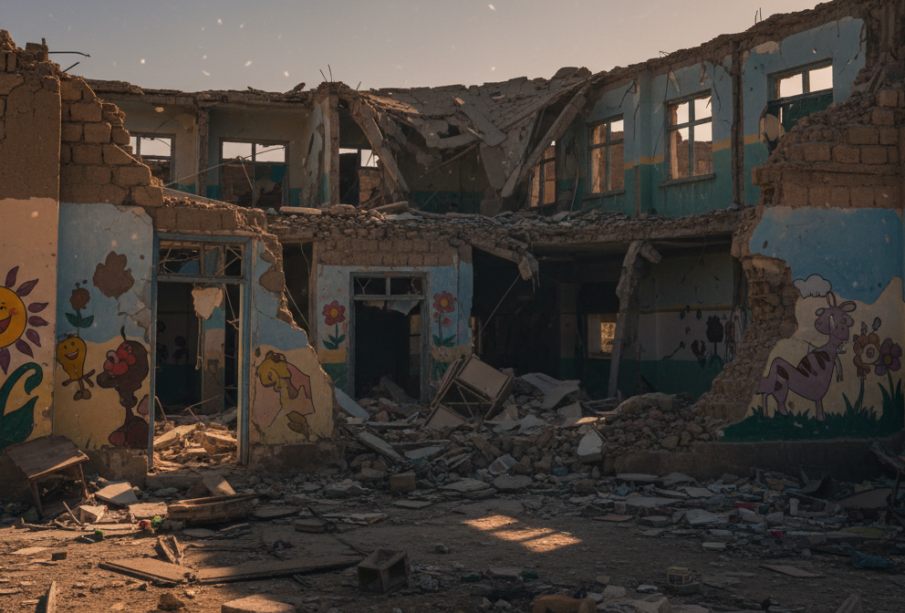
A preliminary military investigation has determined that American forces were responsible for a devastating Tomahawk missile strike on an elementary school in southern Iran that killed at least 175 people, mostly children.
The Deadliest Day
It was just after 10 a.m. on February 28 when the war came to the Shajareh Tayyebeh elementary school in Minab, a small town in southern Iran. The two-story building, painted with pink flowers and green leaves, was filled with young girls attending their morning classes when parents began receiving panicked phone calls. The first wave of U.S.-Israeli airstrikes had begun.
There wasn’t enough time to evacuate. Within minutes, a Tomahawk cruise missile struck the school compound, killing at least 175 people according to Iranian officials. Most were children between the ages of 6 and 12. The strike would become one of the deadliest incidents involving civilian casualties by American forces in decades.
Evidence Mounts Against U.S. Claims
For days after the attack, President Trump insisted that Iran was responsible for bombing its own school. ‘In my opinion, based on what I’ve seen, that was done by Iran,’ Trump told reporters aboard Air Force One on March 7. ‘They’re very inaccurate, as you know, with their munitions. They have no accuracy whatsoever.’
But the evidence told a different story. Video footage released by Iranian state media and verified by multiple news organizations showed what munitions experts identified as an American Tomahawk missile striking the area. Satellite imagery revealed precision strikes on at least six buildings within the adjacent Islamic Revolutionary Guard Corps naval base. Missile fragments recovered from the scene bore markings reading ‘Made in USA’ and the names of American defense contractors.
The United States is the only country involved in the conflict known to possess Tomahawk missiles. Even Israel, America’s closest ally in the region, doesn’t have them.
A Targeting Error Decades in the Making
According to a preliminary Pentagon investigation obtained by multiple news outlets, the strike resulted from what officials describe as a catastrophic targeting error. Officers at U.S. Central Command created target coordinates using outdated intelligence provided by the Defense Intelligence Agency.
The school had once been part of the IRGC naval base, but satellite imagery shows it was walled off and converted to civilian use between 2013 and 2016. By 2025, the compound featured colorful murals, playground equipment, and sports fields – clear indicators of its educational purpose. Yet somehow, this transformation never made it into American targeting databases.
‘The most likely scenario at this point is that somewhere along the way in the targeting process, there was an intelligence failure,’ said N.R. Jenzen-Jones, director of Armament Research Services, a technical intelligence consultancy.
Presidential Denials Crumble
As evidence mounted, Trump’s explanations became increasingly contradictory. On Monday, March 9, he claimed that Iran ‘also has some Tomahawks’ – a statement that munitions experts immediately debunked. Only five countries are known to possess or have agreements to purchase Tomahawk missiles: the United States, United Kingdom, Australia, Japan, and the Netherlands.
When pressed by reporters about why he was the only administration official blaming Iran, Trump’s response was telling: ‘Because I just don’t know enough about it.’ Defense Secretary Pete Hegseth, standing beside the president during earlier statements, had notably declined to echo Trump’s claims.
By Wednesday, March 11, when asked about the Pentagon’s preliminary findings, Trump claimed ignorance entirely: ‘I don’t know about that.’
The Human Cost of War
The strike has drawn condemnation from international bodies and raised serious questions about civilian protection protocols. UNESCO described the killing of students as a ‘grave violation’ of protections for educational facilities under international humanitarian law.
Retired Master Sergeant Wes Bryant, who worked in the Pentagon’s Civilian Protection Center until the Trump administration reduced its size, noted that the precision of the strikes suggested deliberate targeting. ‘I could already tell, when initial reports came out on this strike, just looking at the damage, that this was a deliberately targeted strike package,’ he said.
The tragedy has highlighted cuts to civilian protection programs under the current administration. According to officials, the Pentagon’s office dedicated to preventing civilian casualties has been reduced by 90 percent, with similar cuts at regional commands.
Accountability in Question
The formal Pentagon investigation is expected to take months and will include interviews with everyone involved in the targeting process, from planners to those who carried out the strike. If confirmed, it would rank among the military’s most deadly incidents involving civilians in decades.
The incident has already cast a shadow over Operation Epic Fury, the joint U.S.-Israeli military campaign against Iran. Congressional Democrats have demanded answers, with Senate Minority Leader Chuck Schumer calling Trump’s claims about Iranian Tomahawks ‘beyond asinine.’
For the families in Minab who lost children that February morning, the investigation’s findings may provide answers. But they cannot restore the young lives lost to what appears to be a preventable tragedy born of outdated intelligence and insufficient oversight in an age of precision warfare.





We bring you daily news from around the world. From technology to lifestyle to design and music.