California’s Robot-Built Neighborhood: Inside the $375,000 3D-Printed Homes Changing Construction Forever
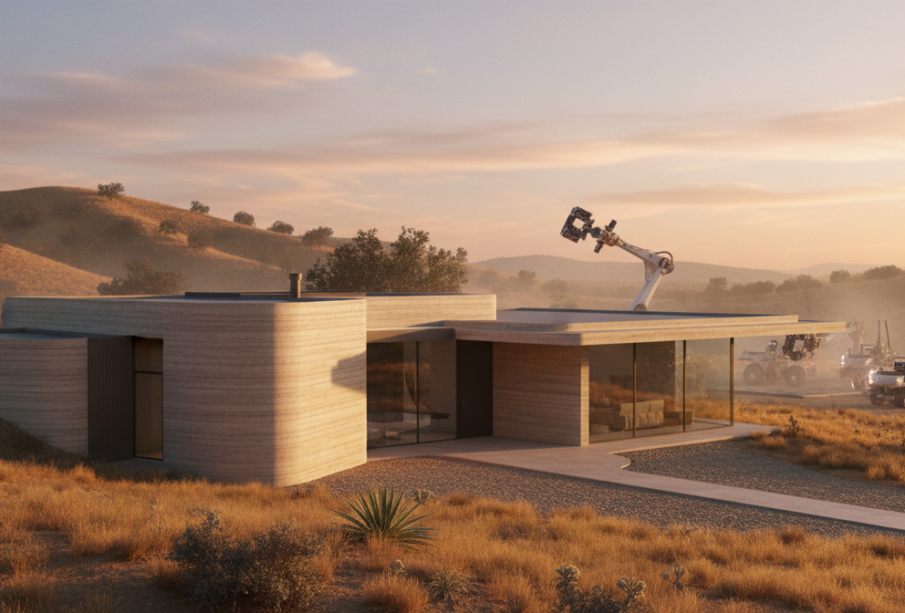
In a small experimental community north of Sacramento, giant robots are printing entire houses from concrete, layer by layer. The first home just hit the market for $375,000, promising to revolutionize how America builds.
The Future Rises in Yuba County
Standing in what will soon be California’s first 3D-printed neighborhood, you can hear the future being built. The mechanical hum of the ARCS printer – a $1.5 million robotic construction system – fills the air as it glides along metal tracks, extruding concrete with surgical precision. Layer by layer, inch by inch, it’s creating something that would have seemed like science fiction just a decade ago.
The 4DIFY project in Yuba County, about 40 miles north of Sacramento, represents more than just technological novelty. It’s a potential answer to California’s crushing housing crisis, where median home prices have soared beyond the reach of middle-class families. The first 1,000-square-foot home in this five-house cluster is now listed for $375,000 – roughly $83,000 below the county’s median home price of around $450,000.
‘We want the machine to do the heavy lifting,’ Nan Lin, founder of 4DIFY, told reporters. ‘We want the humans to do detailed work that the machines can’t do yet.’ It’s a philosophy that could reshape an industry still largely dependent on methods that haven’t fundamentally changed in decades.
From Concrete Dreams to Reality
The technology behind these homes comes from SQ4D, a New York-based company that developed the Autonomous Robotic Construction System. The ARCS printer operates like a massive 3D printer, but instead of plastic filament, it extrudes a concrete mixture made from Portland cement, water, and sand.
What took 24 days to print for the first home should drop to just 10 days as the team refines their process. Compare that to traditional construction, which typically requires five to 10 workers over several months. The 3D printing process uses crews of just three to five people working alongside the machine.
The concrete walls aren’t just faster to build – they’re demonstrably stronger. Lin claims the walls are bulletproof, having withstood ballistic testing with handguns and machine guns. More practically for homeowners, the concrete construction offers natural resistance to fire, mold, and pests – potentially cutting insurance costs in half while reducing energy bills by up to 50% due to superior thermal efficiency.
Beyond the Hype: Real-World Challenges
Having covered construction booms and busts across two continents, I’ve learned to look beyond the promotional materials. While the Yuba County project is genuinely groundbreaking, the economics aren’t quite as revolutionary as the headlines suggest.
At $375 per square foot, the 3D-printed home actually costs more per square foot than the county median of $268. The savings come primarily from reduced labor costs and faster construction timelines, not necessarily cheaper materials. The ARCS printer itself represents a significant capital investment that must be amortized across multiple projects.
Moreover, current 3D printing technology can only handle walls and foundations. Roofs still require traditional wood trusses and metal coverings, though 4DIFY is exploring fully 3D-printed concrete roofs for future designs. Electrical, plumbing, and finishing work still require conventional methods and skilled tradespeople.
Scaling the Revolution
The real test lies ahead. 4DIFY has ambitious plans: 19 units currently in design phase for Sacramento, and a 75-100 unit duplex project in Southern California. The company believes it could eventually build 100 homes per year with refined processes.
This isn’t just about California. Similar 3D printing projects are emerging across the country, with Texas leading the charge with communities as large as 100 homes. The technology’s potential becomes particularly compelling in disaster recovery scenarios, where speed and durability matter most.
‘We are already preparing to print additional homes on the same site, applying what we’ve learned to improve efficiency, coordination, and speed,’ 4DIFY stated. ‘Each build strengthens our process and brings us closer to scalable, repeatable deployment.’
Whether 3D-printed homes represent a fundamental shift or remain a niche solution will depend on factors beyond technology: regulatory approval, consumer acceptance, and the industry’s willingness to embrace radical change. But in Yuba County, the future is already taking shape, one concrete layer at a time.







We bring you daily news from around the world. From technology to lifestyle to design and music.