Physicist Claims Gravity Proves We’re Living in a Computer Simulation
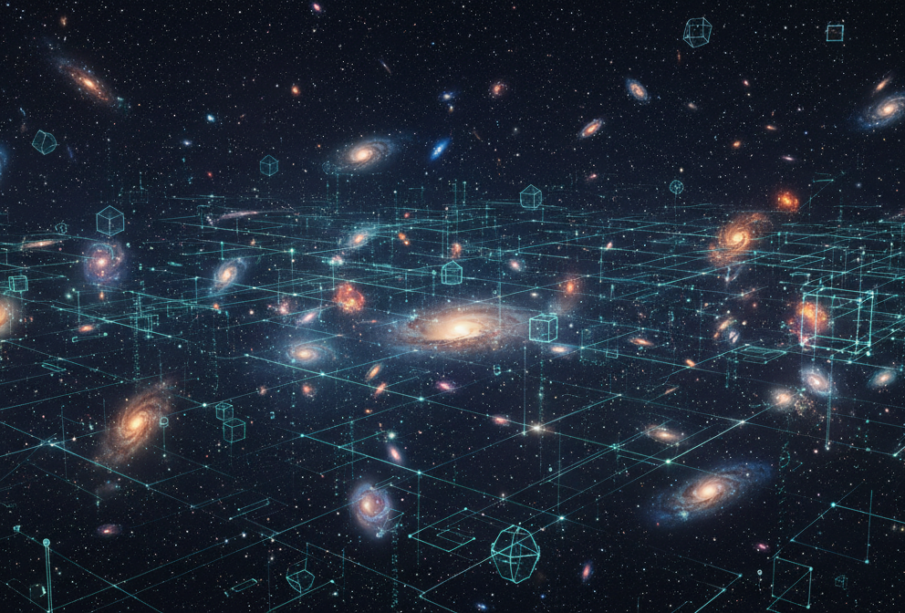
A University of Portsmouth scientist believes he’s found evidence that our universe operates like a giant computer, with gravity serving as an optimization process to keep information organized.
The Digital Universe Theory Gets a Gravitational Twist
What if gravity isn’t just a force pulling objects together, but actually evidence that our entire universe is running on some cosmic computer? That’s the bold claim from Dr. Melvin Vopson, a physicist at the University of Portsmouth who’s been making waves with his research into what he calls the ‘Second Law of Infodynamics.’
Vopson’s latest paper, published in April 2025 in the journal AIP Advances, suggests that gravity might be the universe’s way of staying organized – like a computer compressing files to save storage space. ‘My findings in this study fit with the thought that the universe might work like a giant computer, or our reality is a simulated construct,’ he explains. ‘Just like computers try to save space and run more efficiently, the universe might be doing the same.’
The idea builds on his previous work studying how information behaves differently from regular physical matter. While traditional entropy (disorder) always increases over time according to the second law of thermodynamics, Vopson argues that information entropy actually decreases – creating a kind of cosmic balancing act.
COVID Mutations Sparked the Discovery
Vopson’s journey to this conclusion began with an unlikely subject: the SARS-CoV-2 virus that causes COVID-19. As the pandemic raged and the virus mutated into countless variants, he noticed something strange about how these genetic changes occurred.
‘The best example of something that undergoes a number of mutations in a short space of time is a virus,’ Vopson noted. ‘The pandemic has given us the ideal test sample as SARS-CoV-2 mutated into so many variants and the data available is unbelievable.’
Analyzing the virus’s RNA sequences, he found that information entropy decreased over time with each mutation – the opposite of what random chance would predict. Instead of chaotic, random changes, the mutations seemed to follow a pattern that minimized information complexity. This suggested to him that even biological evolution might not be as random as Darwin originally thought.
‘If we can start looking at genetic mutations from a deterministic point of view, we can exploit this new physics law to predict mutations – or the probability of mutations – before they take place,’ Vopson argues.
Space as Digital Storage
In his latest research, Vopson proposes that space itself might be pixelated – divided into tiny cells that act like digital storage units. Each cell can register information in binary: a ‘0’ if it’s empty, a ‘1’ if matter is present.
‘The process is identical to how a digital computer game, virtual reality application, or other advanced simulation would be designed,’ he explains. When multiple particles occupy nearby cells, the system naturally evolves to merge them into larger particles within single cells – creating gravitational attraction as a byproduct of information compression.
This isn’t just theoretical speculation. Vopson points to real phenomena that might support his ideas, from the mathematical symmetries we see throughout nature to the way black holes seem to process information. ‘A high symmetry corresponds to a low information entropy state, which is exactly what the second law of infodynamics requires,’ he notes.
Scientific Skepticism and Future Tests
Of course, extraordinary claims require extraordinary evidence, and Vopson readily admits he doesn’t have definitive proof yet. The scientific community remains largely skeptical, with many researchers pointing out that his ideas, while intriguing, are still highly speculative.
‘Extraordinary claims require extraordinary evidence, and so far we do not have that at all,’ acknowledges one analysis of his work. ‘In fact, we aren’t even close. However, the ideas and results presented are intriguing and interesting, even if further study or scrutiny proves them incorrect.’
Vopson has published his theories in his 2023 book ‘Reality Reloaded: The Scientific Case for a Simulated Universe’ – a playful nod to The Matrix Reloaded. He’s also co-founded the Information Physics Institute to further research in this emerging field.
Whether we’re living in base reality or some advanced civilization’s simulation remains an open question. But Vopson’s work represents a fascinating attempt to bridge physics, information theory, and philosophy – pushing us to reconsider fundamental assumptions about the nature of reality itself.





We bring you daily news from around the world. From technology to lifestyle to design and music.