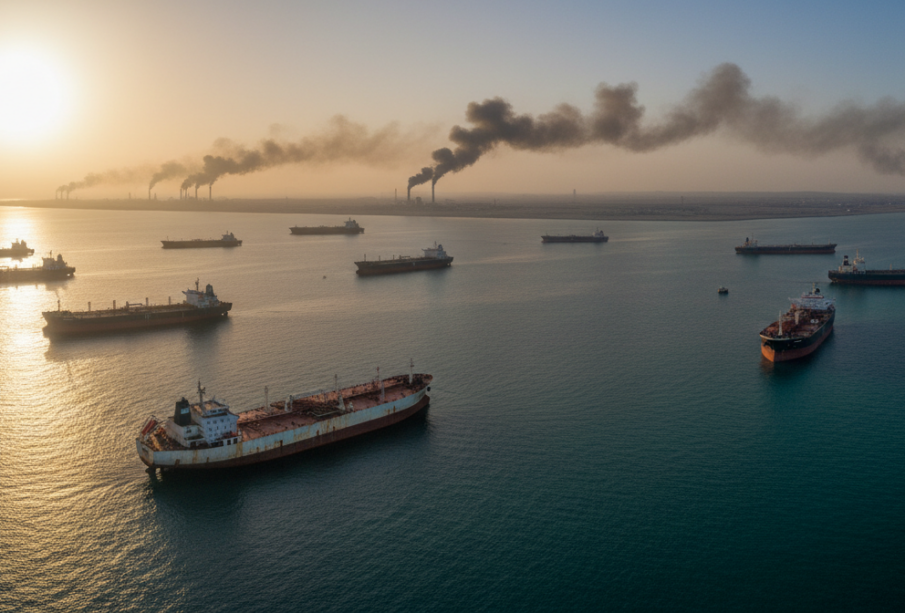
The death of Ayatollah Ali Khamenei in joint US-Israeli strikes has plunged the Middle East into unprecedented chaos, with Iran closing the vital Strait of Hormuz and global oil markets in turmoil.
A Seismic Shift in the Middle East
The Middle East woke up to a fundamentally different reality on March 1st. Ayatollah Ali Khamenei, Iran’s Supreme Leader for nearly four decades, was killed in coordinated strikes by the United States and Israel. The 86-year-old cleric died alongside his daughter, son-in-law, and granddaughter when missiles struck his compound in Tehran during what the Pentagon has dubbed ‘Operation Epic Fury.’
This wasn’t just another military escalation. For the first time since Iran’s 1979 revolution, the country faces a complete leadership vacuum at its highest levels. President Trump and Israeli Prime Minister Netanyahu made their intentions crystal clear: this operation aims for nothing less than regime change in Iran.
‘Take over your government,’ Trump told the Iranian people in a video posted at 2:30 AM. ‘It will be yours to take. This will be probably your only chance for generations.’ The message was unmistakable – Washington and Jerusalem are betting everything on popular uprising to finish what their bombs started.
The Strait of Hormuz: A Global Chokepoint Under Siege
Iran’s response was swift and devastating for global commerce. The Strait of Hormuz, through which roughly 20% of the world’s oil flows daily, has been effectively closed. Iranian Revolutionary Guard vessels broadcast warnings on emergency radio channels: ‘No ship is allowed to pass.’
The numbers tell the story of global panic. Oil prices have already spiked from $66 to over $120 per barrel in just 48 hours. At its narrowest point, the strait is only 21 miles wide, with shipping lanes just 2 miles in each direction – making it devastatingly vulnerable to Iranian naval mines and fast attack boats.
Major shipping companies have pulled out entirely. Hapag-Lloyd suspended all transits ‘until further notice,’ while satellite data shows at least 150 oil tankers anchored in open waters, afraid to approach the waterway. One Palau-flagged tanker was already struck five miles north of Oman’s Khasab Port, signaling Iran’s willingness to target commercial vessels.
The economic implications stretch far beyond energy markets. With both the Strait of Hormuz and the Red Sea now effectively closed to commercial shipping, global supply chains face their worst disruption since World War II.
Nuclear Negotiations Collapse Into War
The timing of the strikes has left diplomats stunned. Just days before the attack, Iranian and American negotiators were in Geneva, reportedly close to a breakthrough on Iran’s nuclear program. Oman’s Foreign Minister had announced that Iran agreed to ‘never stockpile enriched uranium’ and accept full international verification.
‘A deal was at our reach,’ Iranian Foreign Minister Abbas Araghchi told NBC News from Tehran, his voice heavy with disbelief. ‘We were able to address serious questions related to Iran’s nuclear program… I don’t know why while the talks were ongoing, they decided to attack us.’
But Trump and Netanyahu had apparently made their decision weeks earlier. The strikes targeted not just military installations but Iran’s entire nuclear infrastructure – facilities that Trump claimed were being rebuilt after previous attacks in June 2025. ‘We are going to destroy their missiles and raze their missile industry to the ground,’ Trump declared. ‘We’re going to annihilate their navy.’
A Region Braces for the Unknown
Iran has already named Ayatollah Alireza Arafi as interim Supreme Leader, but the succession process remains murky. Only twice in the Islamic Republic’s history has the country faced such a transition, and never under wartime conditions.
The human cost continues to mount. Iranian Red Crescent reports over 200 dead and 747 injured across 24 provinces. In response, Iran has launched unprecedented retaliatory strikes across the region, hitting targets in Israel, Qatar, the UAE, Kuwait, Bahrain, and Saudi Arabia.
From my years covering conflicts across this region, I’ve seen how quickly calculated military operations can spiral into uncontrollable chaos. The 1984-1988 Tanker War, when Iran and Iraq targeted each other’s shipping for four years, offers a sobering precedent. That conflict saw 411 vessels attacked despite Western naval intervention.
Tonight, as oil tankers sit motionless in the Gulf and Iranian forces flood Tehran’s streets, the Middle East stands at a crossroads. Trump and Netanyahu have rolled the dice on regime change, but history suggests that toppling governments from 30,000 feet is far easier said than done. What happens next will reshape not just Iran, but the entire global order built around Middle Eastern energy flows.




We bring you daily news from around the world. From technology to lifestyle to design and music.