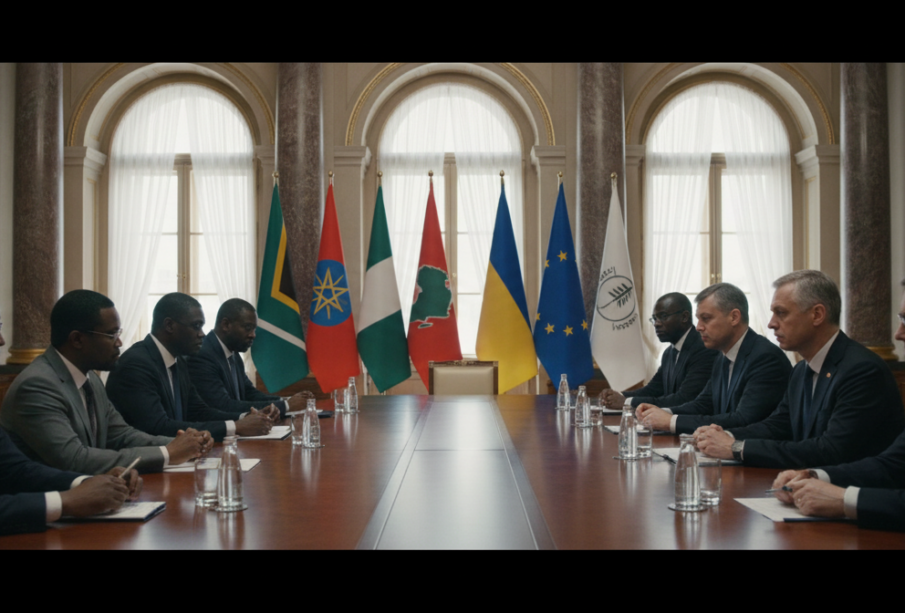
Ghana’s Foreign Minister Samuel Ablakwa made a rare diplomatic visit to Ukraine, meeting with President Zelenskyy to secure the release of two Ghanaian prisoners of war captured while fighting for Russian forces.
A Diplomatic Mission to Kyiv
In an unprecedented move for an African foreign minister, Samuel Okudzeto Ablakwa traveled to Kyiv this week to meet directly with Ukrainian President Volodymyr Zelenskyy. The mission had one clear objective: securing the release of two Ghanaian citizens currently held as prisoners of war in Ukraine.
The February 25th meeting marked a significant diplomatic moment. Ablakwa was granted what he described as ‘rare access to the highly fortified security camp where prisoners of war are being detained.’ This kind of access is virtually unheard of for foreign diplomats, making the gesture all the more remarkable.
‘I can confirm that our citizens are alive and well,’ Ablakwa reported after visiting the detention facility. ‘Their rights under international law have been commendably respected by Ukrainian authorities.’ The minister expressed gratitude to both Zelenskyy and Foreign Minister Andrii Sybiha for facilitating what he called ‘the first of its kind from an African Foreign Minister.’
The Human Cost of Deception
The two Ghanaians are part of a much larger and troubling pattern. According to Ukrainian officials, over 1,780 citizens from 36 African countries are currently fighting in Russian ranks. These aren’t traditional mercenaries seeking profit – they’re victims of an elaborate deception network.
The recruitment tactics are sophisticated and predatory. Russian agents promise monthly salaries of $2,200 to $2,500 – roughly ten times what many can earn at home. They offer signing bonuses of up to $2,000, Russian passports, and what appears to be legitimate employment. Instead, recruits find themselves thrust into frontline combat with minimal training.
‘They were just lured and deceived and then put on the front lines,’ Ablakwa explained. Many have no military background whatsoever. They’re carpenter, students, unemployed youth – people desperate for opportunity who instead find themselves in what one described as ‘hell.’
A Continental Crisis
The scale of African recruitment has become a continental security issue. Kenya’s National Intelligence Service reports that 1,000 of its citizens have been recruited under false pretenses. Cameroon has banned military personnel from traveling abroad without special permission after so many soldiers deserted to join Russian forces.
The human cost is staggering. According to Swiss investigative group INPACT, at least 316 Africans have died in the conflict, with Cameroon recording 94 deaths and Ghana 55. These aren’t just statistics – they represent families destroyed by a recruitment system that treats young Africans as what one Russian soldier called ‘disposable ones.’
South Africa recently secured the return of 11 of its nationals who were ‘lured’ into fighting for Russia. The daughter of former President Jacob Zuma resigned from parliament over allegations she was involved in recruitment schemes.
Beyond Prisoner Exchange
Ablakwa’s mission extended beyond the immediate prisoner release. The talks with Zelenskyy explored how Ghana and Ukraine can combat the trafficking networks that prey on vulnerable African youth. The two countries agreed to deepen cooperation in agriculture, defense, education, and trade.
Zelenskyy extended a formal invitation to President John Mahama to visit Kyiv, signaling Ukraine’s interest in strengthening ties with African nations. This diplomatic outreach comes as Ukraine seeks to counter Russian influence across the continent.
The captured Ghanaians, whose identities remain concealed for security reasons, have reportedly expressed willingness to become advocates against the recruitment networks. ‘They are determined to become advocates against the modus operandi of trafficking networks and are willing to devote the rest of their lives to educating vulnerable Africans,’ Ablakwa noted.
As Ghana prepares to assume the African Union presidency next year, Ablakwa pledged to raise continental awareness about these deceptive recruitment practices. The hope is that diplomatic pressure and public awareness can help stem the flow of young Africans into foreign conflicts they never chose to join.






We bring you daily news from around the world. From technology to lifestyle to design and music.