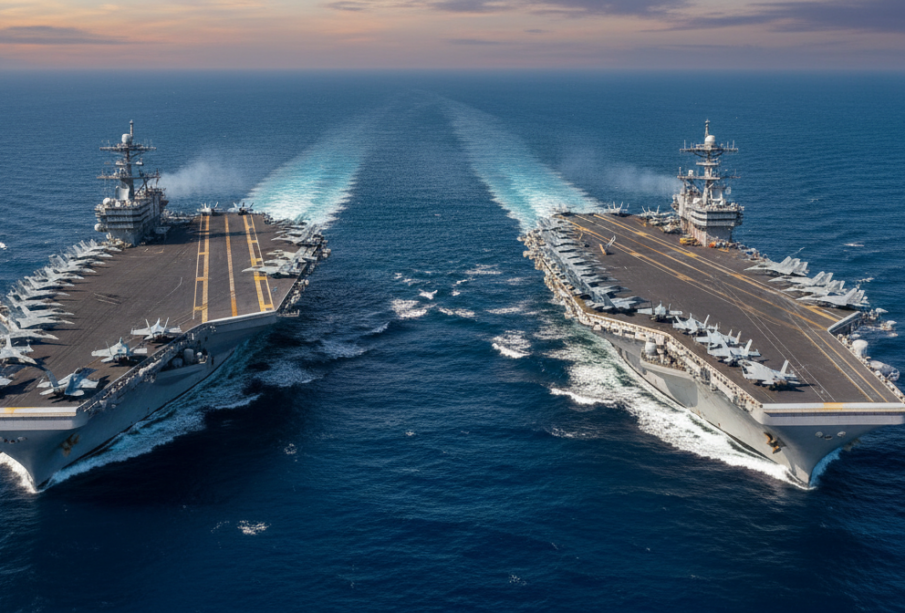
With two aircraft carriers now steaming toward Iranian waters and a 10-day deadline looming, President Trump is betting massive military pressure can force Tehran into the nuclear deal that has eluded Washington for decades.
The Armada Assembles
The numbers tell the story of America’s most significant military buildup in the Middle East since the 2003 Iraq invasion. The USS Gerald R. Ford, the world’s largest aircraft carrier, is crossing the Atlantic for the second time in eight months, joining the USS Abraham Lincoln already positioned 435 miles from Iran’s coast. Together, these floating airbases carry more than 150 fighter jets and can generate what military analysts call ‘several hundred strike sorties a day for weeks.’
The Ford’s journey represents a dramatic pivot from its Caribbean deployment, where it helped capture Venezuelan President Nicolás Maduro just weeks ago. Now, accompanied by four destroyers armed with Tomahawk cruise missiles capable of striking targets 1,000 miles away, it’s steaming toward what could become the epicenter of the next Middle Eastern conflict.
Beyond the carriers, President Trump has orchestrated a massive air surge. More than 50 fighter aircraft – including F-22 Raptors, F-35 Lightning IIs, and F-16 Falcons – flew eastward on Tuesday alone, joining forces already stationed across Jordan, the UAE, and Saudi Arabia. Six E-3 Sentry AWACS aircraft, critical for command and control, now operate from Prince Sultan airbase in Saudi Arabia.
The 10-Day Ultimatum
Trump’s timeline is brutally simple: Iran has 10 to 15 days to accept his nuclear demands, or face consequences he describes as ‘very traumatic.’ Speaking aboard Air Force One Thursday, the president made clear his patience has limits. ‘We’re either going to get a deal, or it’s going to be unfortunate for them,’ he warned.
The stakes couldn’t be higher. Trump is demanding Iran abandon uranium enrichment entirely – a position Tehran has consistently rejected as a ‘non-starter.’ Unlike the 2015 nuclear agreement that limited Iran’s program in exchange for sanctions relief, Trump wants complete dismantlement plus restrictions on Iran’s ballistic missile arsenal.
White House Press Secretary Karoline Leavitt made the administration’s position crystal clear Wednesday: ‘Iran would be very wise to make a deal with President Trump.’ Her words carried extra weight given that just eight months ago, Trump authorized B-2 stealth bombers to strike Iranian nuclear facilities in what was dubbed ‘Operation Midnight Hammer.’
Geneva’s Fragile Progress
The diplomatic dance in Geneva offers a stark contrast to the military buildup. Trump’s special envoy Steve Witkoff and son-in-law Jared Kushner spent hours in indirect talks with Iranian officials Tuesday, mediated by Oman. Iranian Foreign Minister Abbas Araghchi emerged claiming ‘good progress’ on ‘guiding principles,’ but acknowledged the path to agreement remains long.
The gulf between positions remains vast. Iran insists its nuclear program serves peaceful purposes and refuses to discuss its missile capabilities. The Islamic Republic has already rejected zero uranium enrichment, viewing it as capitulation to American threats. ‘What is not on the table: submission before threats,’ Araghchi wrote on social media before the talks.
Yet both sides seem motivated to continue. Iran promised to submit written proposals within two weeks, while Trump indicated he prefers diplomacy to military action. The question is whether Tehran’s proposals will meet Washington’s red lines – or whether Trump’s 10-day deadline will force his hand toward military options.
The Military Math
Military experts are divided on what Trump’s massive deployment actually achieves. Matthew Savill of the Royal United Services Institute notes the assembled forces could sustain bombing campaigns ‘greater than during the 12-day war’ last summer. Even the Lincoln alone could fly 125 bombing missions daily, giving Trump the capability to strike government and military sites across Iran.
But capability doesn’t equal strategy. ‘The question is: what is all this buildup for?’ Savill asks. The last time two U.S. carriers operated simultaneously in Middle Eastern waters was during Operation Midnight Hammer, when American and Israeli forces struck Iranian nuclear facilities. That campaign degraded but didn’t eliminate Iran’s nuclear program.
Today’s deployment faces different challenges. Iran’s missile and drone arsenal – the largest in the Middle East – can reach targets 1,240 miles away, putting U.S. bases across the region at risk. Tehran has also announced joint naval exercises with Russia in the Sea of Oman, adding another layer of complexity to any potential conflict.
The economic stakes are equally daunting. Iran’s recent military exercises in the Strait of Hormuz – through which 31% of global seaborne crude oil flows – sent oil prices surging over 4% in a single session. Brent crude now trades above $71 per barrel, with markets pricing in the risk of wider conflict.




We bring you daily news from around the world. From technology to lifestyle to design and music.