China’s Silent Revolution: Sound Waves Could Transform Industrial Heating
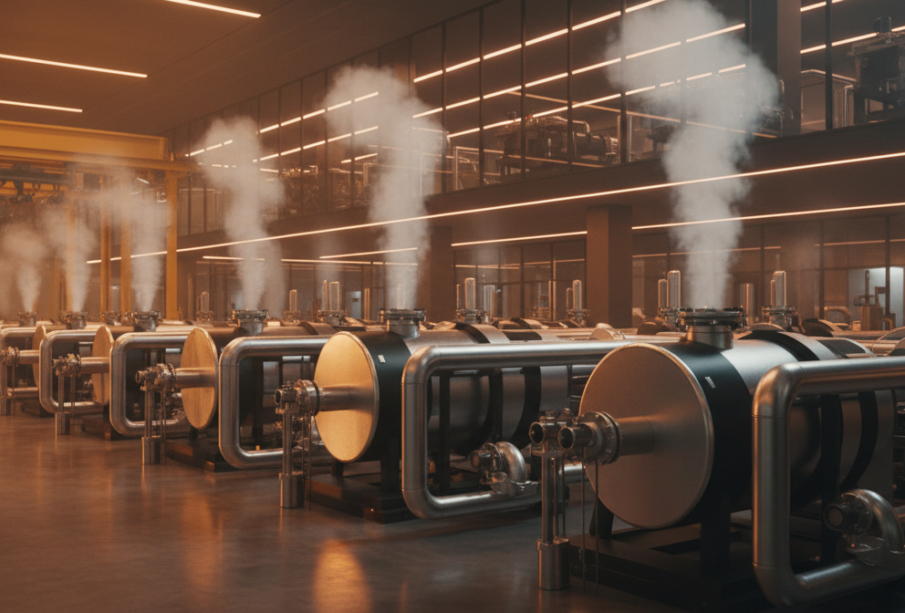
Chinese researchers have built a heat pump that uses sound waves instead of spinning compressors to capture industrial waste heat, potentially revolutionizing how we power everything from factories to data centers.
The Machine That Whispers Heat
Picture this: a factory humming with activity, but instead of the usual mechanical roar of compressors and turbines, there’s something different. A low, steady thrum emanates from a sleek metal cylinder – almost meditative, like a distant transformer. This isn’t your typical industrial equipment. It’s a thermoacoustic heat pump, and it’s turning sound waves into serious heat.
The device, developed by researchers at the Chinese Academy of Sciences, belongs to a family of technologies that sound like science fiction but are grounded in solid physics. Led by physicist Luo Ercang, the team has created what they call ‘the world’s first dual-acting free-piston thermoacoustic Stirling heat pump prototype.’ The name’s a mouthful, but the concept is elegantly simple: use trapped acoustic waves to shuttle heat from one place to another, no spinning parts required.
In lab tests, their prototype achieved something remarkable – it took waste heat at 293°F (145°C) and boosted it to a scorching 518°F (270°C). That’s a temperature jump of 225 degrees Fahrenheit, accomplished with nothing more than carefully choreographed pressure waves moving through metal tubes.
Beyond the Spinning World
Traditional heat pumps are mechanical marvels, but they’re also mechanical headaches. They rely on compressors that spin, refrigerants that can leak, and seals that wear out. When you’re trying to reach the high temperatures that heavy industry demands – think steel mills, chemical plants, or ceramics manufacturing – these conventional systems start to struggle. Most industrial heat pumps tap out around 392°F (200°C), leaving a massive gap for processes that need much hotter temperatures.
The Chinese thermoacoustic design discards that paradigm entirely. Instead of a spinning compressor, it uses an acoustic driver – essentially a sophisticated loudspeaker – to create standing sound waves inside a closed cavity. These waves compress and expand gas in a perfectly timed rhythm, creating a heat-pumping effect that’s both elegant and eerily quiet.
‘The system has no moving mechanical parts,’ explains the research. Instead, it relies on the interaction between sound waves and heat to move thermal energy. Gas molecules dance to the rhythm of acoustic waves, picking up heat at lower temperatures and releasing it at higher ones. It’s like having tiny, invisible engines working in perfect synchronization.
The Data Center Connection
Here’s where things get really interesting for the modern world. Data centers – those massive facilities powering everything from your Netflix stream to ChatGPT queries – are heat-generating monsters. The U.S. alone has over 4,000 data centers, and they’re multiplying rapidly as AI demands explode.
These facilities consume up to 1.5% of global electricity, with cooling systems accounting for nearly 40% of their power usage. Most of that energy ends up as waste heat, literally warming the atmosphere. But what if that ‘waste’ could be harvested and upgraded?
Thermoacoustic heat pumps could be game-changers here. Unlike conventional systems that struggle with the relatively low-grade heat that data centers produce, these sound-powered devices are designed to work with modest heat sources. They could potentially capture the warm exhaust from server rooms and boost it to temperatures useful for heating nearby buildings, powering industrial processes, or even feeding into district heating networks.
In Europe, this isn’t just theoretical. Countries like Germany are already mandating waste heat recovery from large data centers, while cities like Stockholm are pioneering district heating systems powered by data center waste heat.
The 2040 Vision
The Chinese researchers aren’t thinking small. They believe that by 2040, advanced thermoacoustic heat pumps could deliver temperatures up to 2,372°F (1,300°C) – hot enough to power some of the most demanding industrial processes currently dependent on fossil fuels.
This isn’t just about efficiency; it’s about flexibility. These systems don’t care whether their input heat comes from solar thermal collectors, nuclear reactors, or industrial exhaust streams. As long as there’s enough warmth to drive the acoustic waves, the machine can work its magic.
Imagine a future where a petrochemical complex uses solar thermal fields during the day, switches to waste heat from its own processes at night, and only relies on backup fuel to cover gaps. Or picture data centers that don’t just consume electricity but actually become net energy providers to their local communities.
The technology is still in its early stages, and scaling from laboratory prototypes to industrial-scale systems will take time. But the potential is enormous. In China alone, analysts estimate that industrial waste heat represents between 10% and 27% of all energy consumed by factories – energy that’s currently just vented into the atmosphere.
For an industry that’s been stuck with the same basic heat pump design for decades, the whisper of acoustic waves might just be the sound of revolution.







We bring you daily news from around the world. From technology to lifestyle to design and music.