Starlink Shutdown Cripples Russian Forces as Casualty Rates Soar to Historic Levels
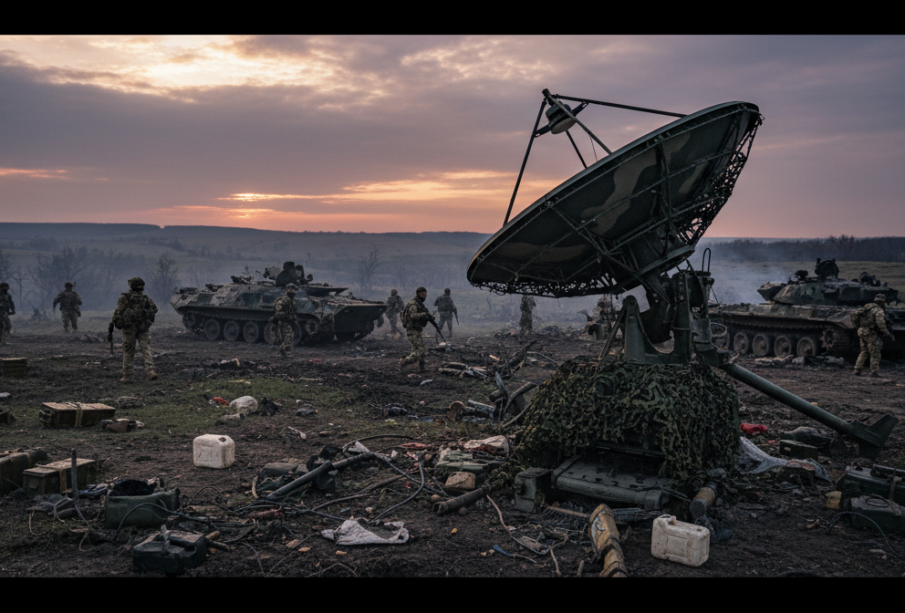
SpaceX’s crackdown on unauthorized Starlink terminals has dealt a devastating blow to Russian military operations in Ukraine, with commanders reporting communication breakdowns and halted assault operations as Moscow’s death toll reaches unprecedented levels.
The Digital Battlefield Revolution
What happens when you suddenly cut off a modern army’s digital lifeline? We’re witnessing the answer unfold across Ukrainian battlefields in real time. On February 1st, SpaceX implemented a comprehensive crackdown on unauthorized Starlink terminals after discovering Russian forces had been mounting the satellite internet systems on attack drones and weapons platforms – a clear violation of the service’s terms that prohibit offensive military use.
The impact was immediate and devastating. Within 72 hours, Russian assault operations ground to a halt across multiple sectors. ‘The enemy on the front lines is facing not just a problem, but a catastrophe,’ said Serhii Beskrestnov, an adviser to Ukraine’s Defense Minister. ‘All command and control of the troops has collapsed.’
This isn’t hyperbole – it’s the reality of 21st-century warfare where satellite internet has become as crucial as ammunition. Russian forces had grown dependent on Starlink’s jam-resistant, high-bandwidth connectivity to coordinate everything from basic troop movements to precision drone strikes deep behind Ukrainian lines.
The Science Behind the Shutdown
The technical solution SpaceX implemented is elegantly simple yet devastatingly effective. Instead of trying to identify individual unauthorized terminals – a digital game of whack-a-mole – the company switched to a ‘whitelist’ system that only allows pre-registered, verified terminals to connect.
‘Soon, only verified and registered terminals will operate in Ukraine. Everything else will be disconnected,’ Defense Minister Fedorov announced on Telegram. The system updates every 24 hours and automatically disconnects any terminal moving faster than 56 mph – a speed restriction designed to prevent drone-mounted usage.
The methodology reveals how modern warfare has evolved. Russian forces weren’t just using Starlink for communications – they were integrating it into their weapons systems. Geran kamikaze drones equipped with Starlink terminals could operate beyond the range of traditional radio control, immune to Ukrainian jamming efforts that had previously made such drones sitting ducks for rifle fire.
Casualty Mathematics Tell a Grim Story
The numbers emerging from this conflict are staggering by any historical measure. Russian forces have suffered approximately 1.25 million casualties since February 2022 – more losses than any major power has sustained in any conflict since World War II, according to the Center for Strategic and International Studies.
To put this in perspective: Russia’s losses in Ukraine are five times higher than all Russian and Soviet losses from every war since WWII combined, including Afghanistan and both Chechen conflicts. The daily death rate has reached levels not seen since the bloodiest battles of the Eastern Front.
Ukrainian commanders report kill ratios that would have seemed impossible just years ago. ‘On any given day, my sector was already achieving 20:1 before the shutdown,’ said a unit commander using the codename ‘Jackie.’ ‘With Starlink down, 13:1 for a regular unit is easy.’ These aren’t boasts – they’re statistical realities reflecting the technological asymmetry that satellite internet created, and that its sudden removal has now reversed.
The Desperate Search for Alternatives
Russian forces are scrambling to fill the communications void, but the alternatives reveal just how dependent they’d become on Western technology. Military bloggers report units begging for donations to buy basic radio equipment, while commanders complain of being ‘like blind kittens’ without their digital connectivity.
The desperation has spawned increasingly creative – and illegal – workarounds. Russian operatives are offering cash to Ukrainian civilians to register Starlink terminals in their names, while others pressure families of captured Ukrainian soldiers to participate in registration schemes. Ukrainian hackers have turned this desperation into an intelligence goldmine, tricking Russian soldiers into revealing their positions while collecting money for fake terminal restoration services.
Moscow’s efforts to develop domestic alternatives have been plagued by delays. Plans to launch the first 16 satellites of a planned 300-satellite constellation were pushed back from late 2025 into 2026 – a timeline that offers little hope for forces currently engaged in active combat operations.
Strategic Implications and the Road Ahead
The Starlink shutdown represents more than a tactical victory – it’s a case study in how technological dependencies can become strategic vulnerabilities. Russian forces built their entire communication architecture around a system they couldn’t control, and now they’re paying the price.
The broader implications extend beyond Ukraine’s borders. This episode demonstrates how private companies controlling critical infrastructure can influence military outcomes in ways previously reserved for nation-states. Musk’s decision to cooperate with Ukrainian requests has effectively shifted battlefield dynamics overnight.
As casualty rates continue climbing and Russian recruitment struggles to keep pace with losses, the communication breakdown couldn’t have come at a worse time for Putin’s forces. With some estimates suggesting Russian deaths in January alone exceeded 31,700 – more than the entire Soviet loss in Afghanistan over a decade – the inability to coordinate effective operations may prove to be the factor that finally tips the scales in this grinding war of attrition.
The lesson for military planners worldwide is clear: in an age where satellites enable everything from navigation to communication, controlling the digital high ground may be just as important as holding physical territory.







We bring you daily news from around the world. From technology to lifestyle to design and music.