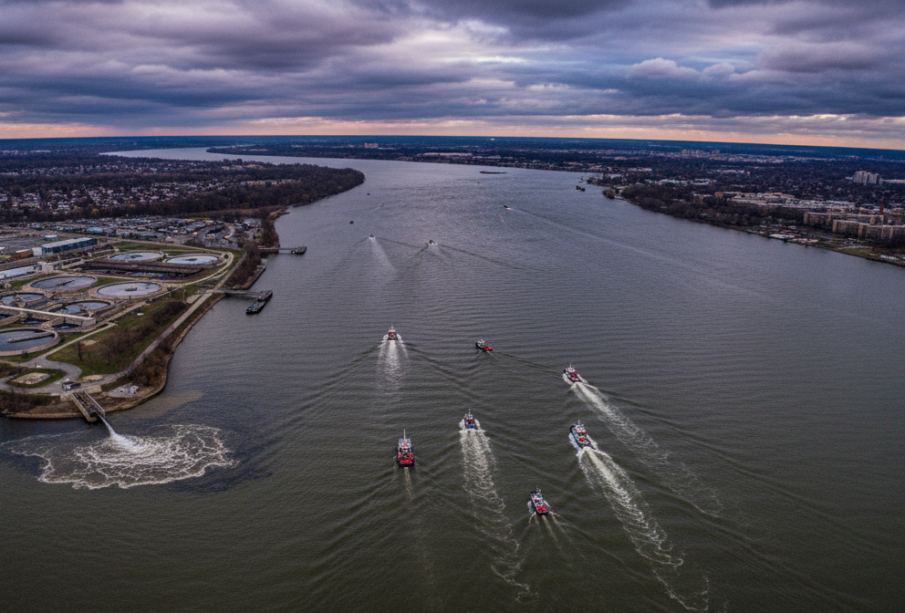
President Trump has directed federal agencies to coordinate cleanup efforts after nearly 250 million gallons of raw sewage poured into the Potomac River from a collapsed sewer pipe, creating what experts call one of the largest wastewater spills in U.S. history.
A Catastrophic Infrastructure Failure
What started as a routine cold snap in January became an environmental nightmare for the nation’s capital. On January 19, a massive 72-inch sewer pipe belonging to DC Water collapsed along the Clara Barton Parkway in Cabin John, Maryland, just northwest of Washington. The rupture unleashed an estimated 243 million gallons of raw sewage directly into the Potomac River – roughly equivalent to filling 370 Olympic-sized swimming pools with untreated wastewater.
The scale of this disaster is staggering. To put it in perspective, that’s enough sewage to cover the entire National Mall in about 3 feet of wastewater. The Potomac Interceptor, a 54-mile-long sewer line that’s more than six decades old, normally carries about 60 million gallons of sewage daily from Dulles Airport in northern Virginia through DC to the Blue Plains Advanced Wastewater Treatment Plant for processing.
Presidential Intervention Amid Political Tensions
President Trump didn’t mince words when he announced federal intervention on Monday. ‘There is a massive Ecological Disaster unfolding in the Potomac River as a result of the Gross Mismanagement of Local Democrat Leaders,’ he declared on Truth Social, specifically targeting Maryland Governor Wes Moore.
The president’s response reflects his broader pattern of federal intervention in Democratic-led areas. He’s directing the Federal Emergency Management Agency (FEMA) to coordinate the response, despite the agency facing significant staff cuts since his return to office. ‘I cannot allow incompetent Local Leadership to turn the River in the Heart of Washington into a Disaster Zone,’ Trump stated.
Governor Moore’s spokesperson, Ammar Moussa, fired back, arguing that Trump has his ‘facts wrong.’ According to Moussa, the federal government has been responsible for the Potomac Interceptor since the last century, and the Trump administration has ‘failed to act’ for the past four weeks.
The Science Behind the Contamination
As a scientist, I find the environmental implications deeply concerning. Raw sewage contains a cocktail of dangerous pathogens – E. coli, salmonella, and other disease-causing bacteria that can survive in water for weeks. The University of Maryland researchers have detected alarmingly high levels of fecal-related bacteria throughout the affected waterway.
What makes this particularly troubling is the timing. Much of the initial overflow occurred during freezing temperatures, which actually helped contain some of the contamination under ice. But as temperatures rise and ice melts, we’re seeing increased bacterial activity and wider dispersal of contaminants. Dean Naujoks from the Potomac Riverkeeper Network describes visible sewage and toilet paper along the riverbank – a stark reminder of the raw nature of this spill.
Health officials have issued warnings extending more than 70 miles downstream, advising people to avoid all contact with the river. The risk isn’t just theoretical – open cuts exposed to this contaminated water could lead to serious infections that resist antibiotic treatment.
Complex Repair Challenges Ahead
The engineering challenge facing DC Water crews is immense. They’ve discovered a 30-foot rock dam inside the collapsed pipe – essentially a massive blockage of boulders and debris that’s complicating cleanup efforts. Think of it like trying to clear a clogged drain, except the ‘drain’ is 6 feet wide and buried under tons of rock.
Crews are currently fabricating a steel bulkhead that will block water flow upstream of the damage, allowing them to safely remove this obstruction. But even after clearing the blockage, the permanent repair using a process called ‘sliplining’ – essentially inserting a new pipe inside the damaged one – could take up to nine months.
The financial implications are staggering too. While some estimates suggest the cleanup could cost at least $10 million, the affected section was already slated for $600 million in upgrades as part of DC Water’s decade-long infrastructure improvement program. This disaster has essentially accelerated that timeline while adding emergency response costs.
Broader Infrastructure Wake-Up Call
This catastrophe highlights a sobering reality about American infrastructure. The Potomac Interceptor is over 60 years old – built when Eisenhower was president and the Interstate Highway System was just beginning. It’s a reminder that much of our critical infrastructure is aging beyond its intended lifespan.
David L. Gadis, CEO of DC Water, acknowledged in an open letter that this incident ‘reinforces why sustained investment and vigilance are essential.’ The utility has been proactive with a $625 million rehabilitation program, but this failure occurred in an area already targeted for upgrades.
Experts are calling this one of the largest sewage spills in U.S. history, comparable only to a 2017 incident near San Diego that released about 230 million gallons. The difference here is location – this happened in the heart of the nation’s capital, affecting a river that’s both a vital water source and a symbol of American heritage.
As cleanup efforts continue and political blame-shifting intensifies, one thing remains clear: this disaster serves as a stark reminder that infrastructure investment isn’t just about convenience – it’s about protecting public health and preserving our most treasured natural resources.






We bring you daily news from around the world. From technology to lifestyle to design and music.