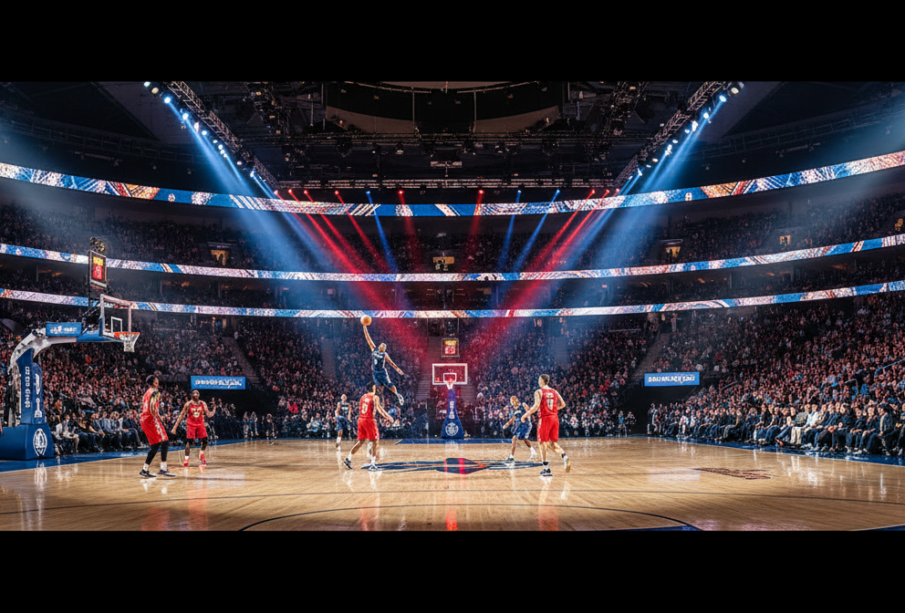
After years of criticism, the NBA’s new USA vs. World format delivered genuine competition and excitement. But sky-high ticket prices left thousands of seats empty at the $2 billion Intuit Dome.
Competition Returns to All-Star Weekend
For the first time in years, the NBA All-Star Game actually looked like basketball. Commissioner Adam Silver‘s bold gamble paid off Sunday night at the Intuit Dome in Inglewood, where a revolutionary USA vs. World format transformed what had become a glorified scrimmage into genuine competition.
The new three-team tournament featured two American squads – USA Stars (younger players) and USA Stripes (veterans) – battling against Team World in four intense 12-minute games. Gone were the lazy 200-195 blowouts and defensive apathy that had turned the showcase into a punchline. Instead, fans witnessed clutch shots, overtime drama, and players who actually seemed to care about winning.
Anthony Edwards of the Minnesota Timberwolves captured MVP honors after leading USA Stars to the championship with 32 points across three games. His performance included a game-tying three-pointer to force overtime and several clutch buckets that helped secure the title. The 24-year-old guard received 10 of 14 MVP votes, edging out Kawhi Leonard, who delivered a spectacular 31-point explosion in just 12 minutes during one of the round-robin games.
The Price of Admission
While the on-court product finally delivered, the atmosphere in the arena told a troubling story. Despite the league claiming the weekend was ‘sold out,’ vast sections of empty seats were visible throughout the Intuit Dome, which holds 18,000 fans but appeared less than half full for many events.
The culprit? Astronomical ticket prices that priced out average fans. Resale tickets for Sunday’s All-Star Game started around $1,000 and climbed past $1,300, with premium seats reaching $3,300. Even Friday’s Rising Stars game averaged $110, while some upper-level seats hit $1,000 on the resale market.
‘Whatever the attendance is like, just know there are over 20,000 basketball fans in Los Angeles that would love to go but can’t afford it when it costs over $900 for the cheapest ticket,’ wrote sports journalist Arash Markazi. The disconnect between the league’s corporate pricing and fan accessibility became impossible to ignore, with social media flooded with images of empty sections and criticism of the NBA’s approach.
Stars Shine Despite the Circumstances
The basketball itself provided plenty of memorable moments. Victor Wembanyama set the competitive tone early, scoring Team World’s first seven points and contesting every shot within his 7-foot-4 wingspan. The San Antonio Spurs phenom finished with 33 points and 8 rebounds across two games, earning praise from Edwards for elevating everyone’s effort level.
Leonard‘s third-game performance became the weekend’s highlight reel. Playing in his home arena, the Clippers star shot 11-of-13 from the field and 6-of-7 from three-point range, including the game-winning shot with 3.5 seconds remaining. His 31-point barrage in 12 minutes drew comparisons to some of the greatest All-Star performances in history.
The format’s success extended beyond individual brilliance. Each of the first three games came down to final possessions, with De’Aaron Fox hitting a buzzer-beating three-pointer and Scottie Barnes delivering an overtime winner. The compressed 12-minute games eliminated the usual coasting, forcing players to compete from the opening tip.
A Blueprint for the Future?
The USA vs. World format appears to have solved the NBA’s All-Star competition problem, at least temporarily. Players praised the intensity and genuine effort, while fans and media responded positively to the meaningful games. Durant noted the improved defensive effort, while Booker emphasized that ‘every team honestly wanted to win.’
However, the attendance crisis threatens to overshadow the on-court success. The league must address the pricing structure that left thousands of seats empty during what should be one of basketball’s premier events. Some suggested radical solutions, like $10 tickets and reduced concession prices to make the experience accessible to families and young fans.
The 75th All-Star Game proved that competitive basketball can return to the showcase with the right format. Now the challenge becomes ensuring that actual fans can afford to witness it in person. Until then, even the most exciting games will play out in half-empty arenas, diminishing the spectacle that All-Star Weekend is meant to provide.






We bring you daily news from around the world. From technology to lifestyle to design and music.