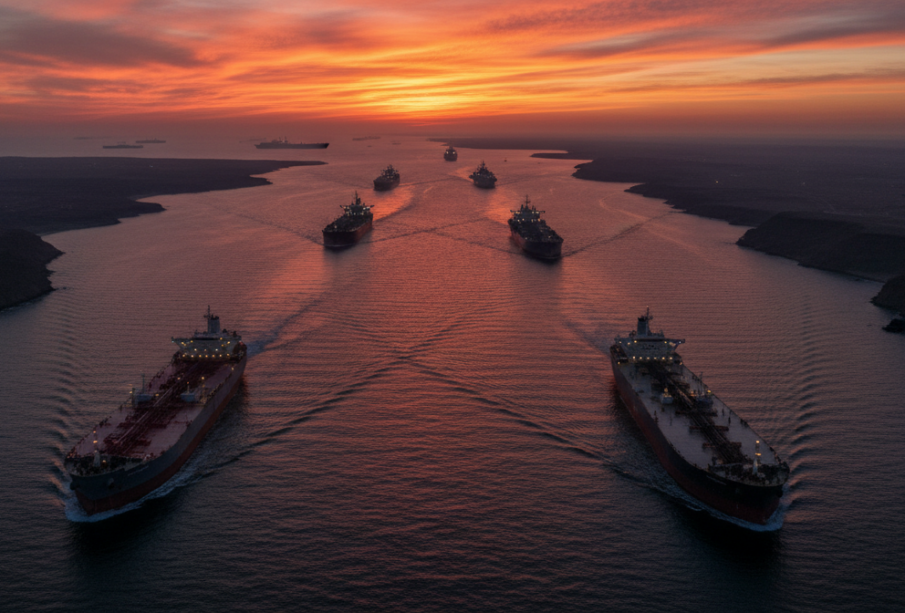
As the US and Iran feel their way toward a nuclear deal, Israel pushes to expand the agenda, warships circle the Persian Gulf, and from Lebanon to Syria, the human cost of unresolved conflicts keeps mounting.
Talking While the Guns Are Loaded
On February 6, the United States and Iran sat down for their first indirect talks since American bombers struck three Iranian nuclear facilities during a 12-day war last June. The venue was Muscat, Oman, with Omani Foreign Minister Badr Albusaidi serving as mediator. The American delegation was led by Special Envoy Steve Witkoff and, notably, included Jared Kushner and Admiral Brad Cooper, the commander of US Central Command, in full dress uniform. An Iranian diplomatic source told Reuters that Cooper’s presence ‘endangered’ the talks.
Iranian Foreign Minister Abbas Araghchi called the session ‘a positive and good start,’ though he stressed the discussions focused ‘solely’ on the nuclear issue. President Trump, speaking aboard Air Force One afterward, described the talks as ‘very good’ and said Iran wants a deal ‘very badly.’ But in the same breath, he warned that the consequences of failure would be ‘very steep.’ This is diplomacy conducted in the shadow of force, not as an alternative to it.
The USS Abraham Lincoln carrier strike group is already in the Arabian Sea. Trump has floated sending a second carrier. Days before the Muscat round, US forces shot down an Iranian Shahed-139 drone approaching the carrier group, while armed Iranian boats attempted to stop a US-flagged oil tanker in the Strait of Hormuz. The US Maritime Administration subsequently advised American-flagged vessels to stay ‘as far as possible’ from Iranian waters.
Netanyahu’s Mission: Missiles, Not Just Nukes
Five days after the Muscat talks, Benjamin Netanyahu flew to Washington for an urgent meeting with Trump. The Israeli prime minister’s message was blunt: any deal with Iran that ignores its ballistic missile program and regional proxy networks would be dangerously inadequate. Israeli intelligence estimates suggest Iran could expand its arsenal to as many as 8,000 missiles by 2028 if left unchecked.
Trump appeared sympathetic. He told Fox Business that a good deal would mean ‘no nuclear weapons, no missiles.’ But after a nearly three-hour closed-door session, he posted on Truth Social that ‘nothing definitive’ had been reached, adding that he ‘insisted that negotiations with Iran continue.’ Netanyahu left Washington without holding a press conference, telling reporters on the tarmac at Joint Base Andrews that he remained skeptical about the possibility of any agreement with Tehran.
Iran’s response was swift and unequivocal. Ali Shamkhani, a senior adviser to Supreme Leader Ayatollah Ali Khamenei, declared that ‘the Islamic Republic’s missile capabilities are non-negotiable.’ Ali Larijani, secretary of Iran’s Supreme National Security Council, accused Israel of fabricating pretexts to derail the negotiations. ‘Our negotiations are exclusively with the United States,’ he said during a visit to Doha. ‘Israel has inserted itself into this process, with their intent on undermining and sabotaging these negotiations.’
The Hormuz Card
Behind the diplomatic maneuvering looms a question that keeps energy analysts awake at night: could Iran close the Strait of Hormuz? About 13 million barrels of crude oil per day transited the strait in 2025, accounting for roughly 31% of global seaborne crude flows. A full closure could spike oil prices by $10 to $20 per barrel, according to Andy Lipow of Lipow Oil Associates.
Iran possesses significant asymmetric capabilities, including an estimated 5,000 to 6,000 naval mines, roughly 25 submarines, coastal anti-ship missile batteries, and thousands of drones. In late January, the Islamic Revolutionary Guard Corps conducted naval exercises in the strait, and hardline lawmakers in Tehran publicly revived calls to close it. Yet most analysts stress that a sustained closure remains a low-probability event. Iran itself ships nearly 95% of its crude exports through Hormuz, primarily to China. Shutting the strait would hurt Beijing’s energy security more than the West’s, since Asian buyers absorb 84% of oil transiting the waterway. As one analysis put it, the threat ‘may be far easier to signal than to carry out.’
Syria’s Prisons and Lebanon’s Occupied South
While the Iran nuclear drama dominates headlines, two other crises in the region grind on with less attention but no less human suffering.
In Raqqa, Syria, the transfer of prisons from the Kurdish-led Syrian Democratic Forces to the new central government has been chaotic and traumatic. Syrian government forces took control of al-Aqtan prison in late January after a two-week offensive, finding up to 2,000 detainees inside. Outside the facility, families pushed against military barricades, desperate for news of relatives they had not heard from in days. Some had been searching for loved ones for years. During the handover, 120 ISIS detainees escaped from a separate prison in Shaddadeh, though authorities later recaptured most of them. The SDF, once Washington’s primary partner against ISIS, has been told its separate role ‘has largely expired.’
In Lebanon, satellite imagery tells a story that contradicts the November 2024 ceasefire agreement. Israel was supposed to withdraw its troops within 60 days. More than a year later, it maintains five fortified positions in the south, with widened access roads and expanded bases visible from space. The Lebanese government reported over 2,000 Israeli ceasefire breaches in the last quarter of 2025 alone. Israeli forces conduct near-daily aerial attacks and regular ground raids, destroying homes and making front-line border villages uninhabitable. Hezbollah leader Naim Qassem has said the group will not accept further disarmament unless Israel starts abiding by the ceasefire.
The Narrowing Space
Having covered this region for years, what strikes me most about the current moment is how narrow the space for diplomacy has become. The US and Iran are talking, which matters. But they are talking through intermediaries, in a palace near Muscat’s airport, while carrier strike groups patrol nearby waters and drones get shot down overhead. Trust, the essential ingredient for any durable agreement, is in desperately short supply.
Iran’s nuclear program suffered a major setback after the June 2025 strikes on facilities at Fordow, Isfahan, and Natanz. But its missile production has reportedly continued, and the domestic unrest that has killed thousands since late 2025 adds another volatile variable. President Masoud Pezeshkian told crowds marking the revolution’s anniversary that Iran ‘will not yield to excessive demands,’ even as he acknowledged the government’s failures.
A second round of US-Iran talks is expected soon, though no date has been confirmed. France, Britain, and Germany have warned they could trigger the snapback mechanism to restore UN sanctions if no deal materializes before the original nuclear agreement expires in October. Trump has given Iran roughly a month. The clock is ticking, and in this part of the world, clocks have a way of running out faster than anyone expects.





We bring you daily news from around the world. From technology to lifestyle to design and music.