AI Cracks 500-Year-Old Art Mystery Hidden in Plain Sight
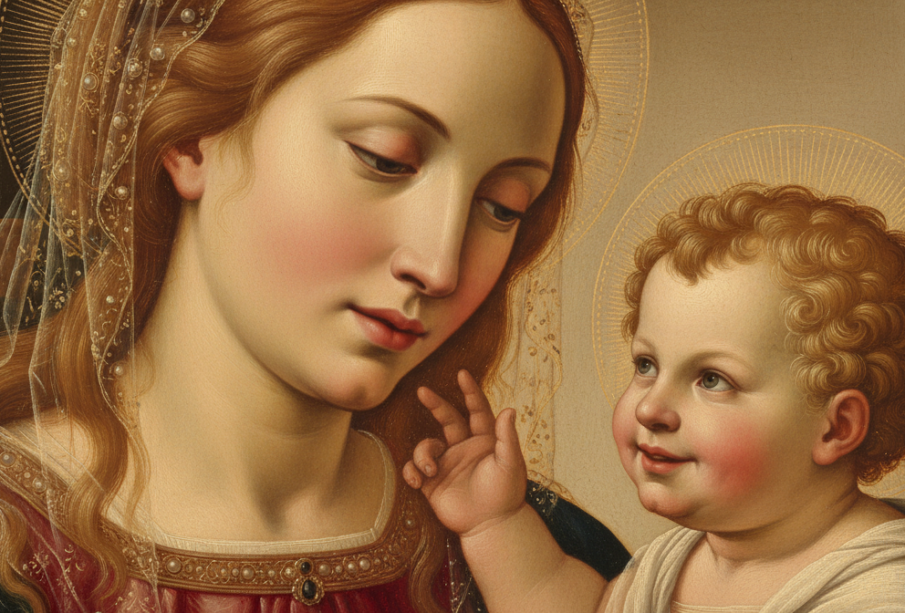
A computer algorithm has finally solved what art historians have debated for centuries. One face in Raphael’s famous Madonna painting wasn’t painted by the Renaissance master himself.
The Face That Didn’t Belong
For over 150 years, something bothered art experts about Raphael’s Madonna della Rosa. The painting shows Mary, baby Jesus, young John the Baptist, and Joseph. But Joseph’s face looked different. Less refined. Almost like an afterthought. The authenticity of Raphael’s Madonna Della Rosa was mostly undisputed for centuries, until 19th-century art historians began questioning whether part of it was actually done by the hand of someone else working in the master’s atelier. What aroused suspicions was the face of St. Joseph in the shadows on the left side of the painting. Art historians suspected one of Raphael’s students might have painted it. But they couldn’t prove it.
Teaching Machines to See Like Masters
Hassan Ugail, a computer scientist at the University of Bradford, had an idea. What if artificial intelligence could spot the difference? This problem led computer scientist Hassan Ugail, of the University of Bradford in the UK, to create a transfer learning algorithm that allows a deep neural network to identify the stylistic hallmarks of an authentic Raphael figure or painting. The algorithm merges deep learning with the detection of boundaries in an image. His team fed the AI dozens of authenticated Raphael paintings. The computer learned to recognize every tiny detail of the master’s style – brushstrokes, shading, color choices. With the details of Raphael’s style painstakingly programmed into the algorithm, the AI model was able to recognize whether an artwork was “Raphael” or “not Raphael” with 98% accuracy.
The Moment of Truth
When they tested the entire Madonna painting, results were unclear. So they tried something different. They asked the AI to examine each face separately. When Ugail’s latest algorithm was applied to the faces in the Madonna Della Rosa, it revealed that the first three were “Raphael,” while St. Joseph was almost definitely “not Raphael.” The computer could see what human eyes couldn’t – microscopic differences in technique that proved Joseph’s face came from a different hand. “The computer sees far more deeply than the human eye, to microscopic levels,” Ugail stated in 2023.
A Student’s Secret Contribution
The AI confirmed what scholars had long suspected. While the faces of the Madonna, Christ Child, and an infant St. John have been attributed to Raphael himself, experts have suggested that the face of St. Joseph was actually painted by another brush, possibly that of Raphael’s student Giulio Romano or Gianfrancesco Penni. This was common practice in Renaissance workshops. Master artists often had apprentices help with less important parts of paintings. The mystery wasn’t whether this happened – it was proving it after 500 years.
Art Meets Algorithm
This breakthrough shows how AI can solve historical puzzles that stumped experts for generations. But Ugail is clear about the technology’s role. “This is not a case of AI taking people’s jobs. The procedure of authenticating a work of art involves numerous factors, including provenance, pigments, and the condition of the piece. However, such software can be instrumental in assisting the overall assessment.” The Madonna della Rosa hangs in Madrid’s Prado Museum, where visitors can now see it with fresh eyes. They’re looking at a masterpiece that’s both entirely Raphael’s vision and partly someone else’s handiwork – a perfect example of how Renaissance art really worked.






We bring you daily news from around the world. From technology to lifestyle to design and music.