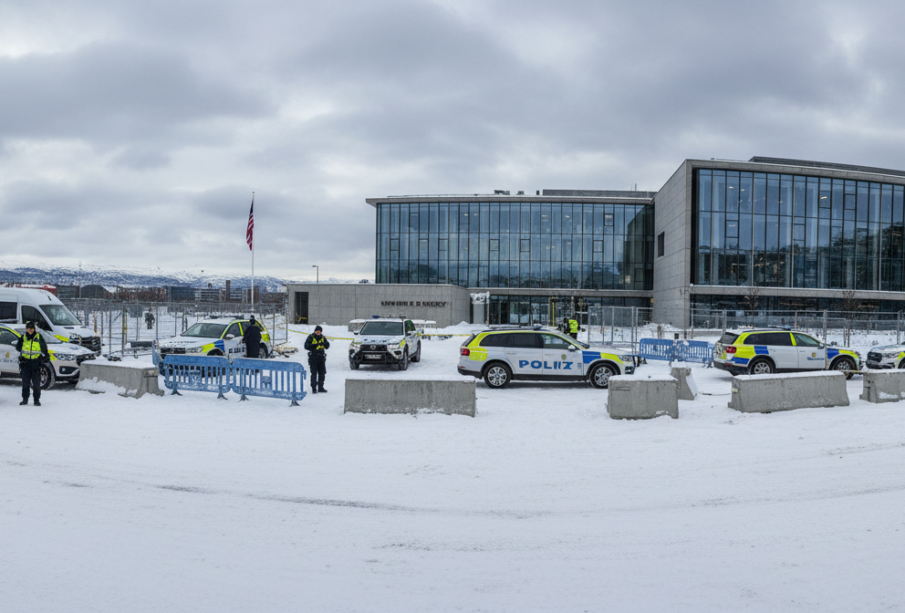
Norwegian authorities arrested three brothers of Iraqi descent Wednesday in connection with a bombing at the U.S. Embassy in Oslo, as investigators probe potential foreign state involvement amid escalating Middle East tensions.
Swift Arrests Follow Weekend Attack
The breakthrough came just three days after an improvised explosive device damaged the entrance to the U.S. Embassy’s consular section in Oslo around 1 a.m. Sunday morning. Police Attorney Christian Hatlo announced that the three suspects – all Norwegian citizens in their 20s with Iraqi heritage – face terrorism charges.
‘They are suspected of a terror bombing,’ Hatlo told reporters at a Wednesday news conference. The siblings, who had not previously been on police radar, allegedly orchestrated an attack that caused minor structural damage but no injuries. One brother is believed to have planted the device, while the other two provided support, according to investigators.
Surveillance footage released earlier showed a hooded figure carrying a backpack near the embassy compound. The device, concealed inside the backpack, created a powerful explosion that filled the street with thick smoke, witnesses reported.
Foreign State Involvement Under Investigation
Norwegian authorities are examining whether the bombing was carried out on behalf of a foreign government – a line of inquiry that has taken on heightened significance given the current Middle East crisis. ‘We are still working from several hypotheses,’ Hatlo explained. ‘One of them is whether this is an order from a government entity.’
The timing appears particularly suspicious. The attack occurred just over a week after Supreme Leader Ali Khamenei was killed in joint U.S.-Israeli strikes on Iran that began February 28. That military operation, dubbed ‘Epic Fury’ by the Pentagon, has triggered a wave of retaliatory attacks across the region.
Norway’s security service PST warned in its annual threat assessment last month that Iran could rely on ‘proxy actors,’ including criminal networks, to carry out attacks. Iran’s ambassador to Oslo has denied any involvement in the embassy explosion.
Part of Broader Pattern of Diplomatic Attacks
The Oslo incident represents just one piece of a troubling puzzle. U.S. diplomatic facilities have faced a series of attacks since the Iran war began. Iranian drones struck the U.S. Embassy in Riyadh, Saudi Arabia, and the U.S. Consulate in Dubai last week. The U.S. Embassy in Baghdad was targeted in a rocket attack Saturday.
Just Tuesday, shots were fired at the U.S. Consulate in Toronto, Canada – an incident Canadian authorities are treating as a national security matter. The State Department has ordered the departure of non-emergency personnel from missions across the Gulf region, including Saudi Arabia, Kuwait, the UAE, Qatar, Bahrain, Iraq, and Oman.
One of the arrested brothers has reportedly admitted to placing the bomb, according to his lawyer Oystein Storrvik, who told broadcaster TV 2 that his client ‘admits that he placed the bomb there.’ However, police maintain all three siblings were involved in the plot.
Escalating Global Consequences
The broader conflict has already claimed hundreds of lives and disrupted global commerce. Iranian strikes have damaged air hubs, rocked populated areas, and disrupted oil shipments. Dubai International Airport, the world’s busiest for international flights, has halted operations indefinitely.
The war began when Israel and the United States launched surprise airstrikes targeting Iranian leadership and nuclear facilities. President Trump has called for regime change, while Israeli Prime Minister Netanyahu said the goal was to ‘remove the existential threat posed by the terrorist regime in Iran.’
Mojtaba Khamenei, son of the killed supreme leader, was elected March 8 to replace his father. The transition has done little to calm tensions, as Iran continues launching retaliatory strikes against U.S. and Israeli targets across the region. For veteran observers of Middle East conflicts, the current crisis represents a dangerous new phase where diplomatic facilities – long considered off-limits – have become legitimate targets in the eyes of combatants.




Leave a reply



We bring you daily news from around the world. From technology to lifestyle to design and music.