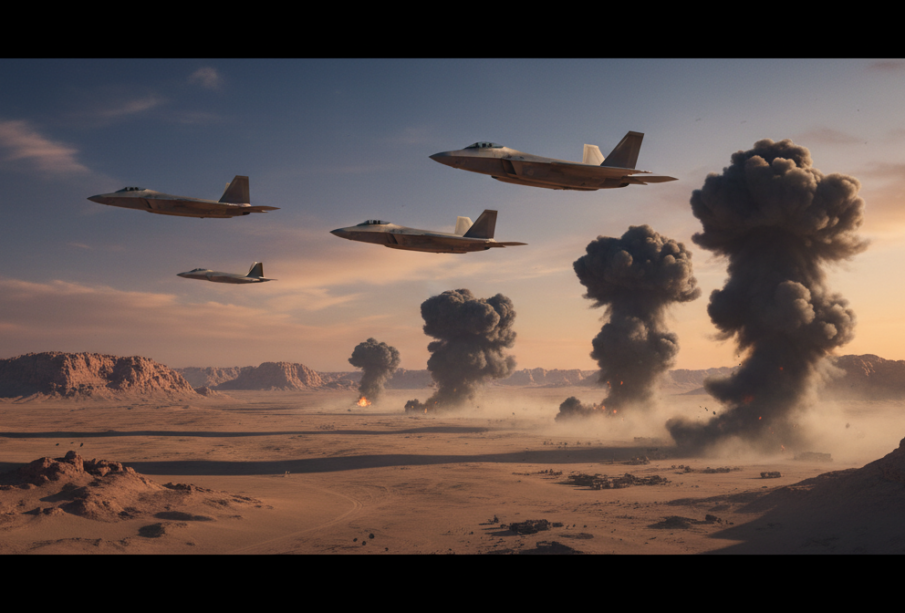
The assassination of Iran’s Supreme Leader Ali Khamenei in joint U.S.-Israeli strikes marks a historic turning point in Middle Eastern geopolitics, triggering a succession crisis and potentially reshaping the region’s balance of power.
Operation Epic Fury: A Calculated Strike
On February 28, 2026, the United States and Israel launched what President Donald Trump dubbed ‘Operation Epic Fury’ – a massive coordinated assault on Iran that achieved what many considered impossible. The operation successfully eliminated Iran’s Supreme Leader Ayatollah Ali Khamenei, who had ruled the Islamic Republic with an iron fist for 37 years.
The 86-year-old ayatollah was killed while working in his office at his Tehran compound, according to Iranian state media. The strike represented the culmination of months of intelligence gathering and target identification by both American and Israeli forces. As one Israeli military official revealed, three separate gatherings of senior Iranian officials were struck simultaneously that Saturday morning.
The operation’s scope extended far beyond Khamenei himself. Israeli Defense Minister Israel Katz confirmed that the strikes decimated Iran’s chain of command, killing seven senior defense and intelligence officials and targeting 30 top military and civilian leaders overall. Among the casualties were Iran’s defense minister, the commander of the Revolutionary Guard Corps, and the secretary of the Iranian Security Council.
From Proxy Wars to Direct Confrontation
The February 2026 strikes marked the latest escalation in a conflict that had been building since the June 2025 ‘Twelve-Day War’ between Israel and Iran. That earlier confrontation saw Israel conduct a major operation targeting Iranian nuclear facilities, military sites, and regime infrastructure, followed by U.S. strikes on Iran’s most fortified nuclear sites.
The path to direct confrontation began with the October 2023 Hamas attack on Israel, which triggered a broader regional conflict. Iran’s network of proxy forces – including Hamas in Gaza, Hezbollah in Lebanon, and the Houthis in Yemen – had been significantly degraded through Israeli military operations over the past two years.
By 2026, Iran found itself increasingly isolated. The fall of Syrian President Bashar al-Assad in December 2024 had further weakened Iran’s ‘Axis of Resistance,’ while massive anti-government protests that erupted in Iran in late December 2025 had killed over 7,000 people according to human rights organizations.
Nuclear Ambitions and Failed Diplomacy
Central to the U.S.-Israeli calculus was Iran’s advancing nuclear program. Despite multiple rounds of indirect negotiations mediated by Oman in early 2026, talks had failed to produce a breakthrough. The International Atomic Energy Agency reported that Iran had acquired enough enriched uranium to produce nine nuclear warheads, with some uranium enriched to 60 percent purity – dangerously close to weapons-grade levels.
The 2015 Joint Comprehensive Plan of Action (JCPOA), which had limited Iran’s nuclear program in exchange for sanctions relief, had been effectively dead since Trump withdrew the U.S. from the deal in 2018. Iran began violating the agreement’s terms in 2019, steadily increasing its uranium enrichment capabilities.
Trump’s return to the presidency in January 2025 initially raised hopes for renewed diplomacy. However, when negotiations faltered in June 2025 and Iran sought to ramp up its uranium enrichment further, Israel launched its first major attack with U.S. support. The February 2026 operation aimed not just to set back Iran’s nuclear program, but to achieve regime change entirely.
Regional Retaliation and Global Implications
Iran’s response to the assassination was swift and extensive. The Islamic Revolutionary Guard Corps launched waves of missiles and drones at Israeli cities and U.S. military bases across the region. Countries including Bahrain, Kuwait, Qatar, the United Arab Emirates, and Saudi Arabia reported being targeted by Iranian strikes.
The scale of Iran’s retaliation exceeded previous conflicts. While past Iranian responses had been limited – such as striking a single U.S. base in Iraq after the 2020 assassination of Qasem Soleimani – this time Iran targeted multiple countries simultaneously. The Iranian Red Crescent Society reported over 200 civilian casualties from the initial U.S.-Israeli strikes.
The conflict’s economic implications are already being felt globally. Oil prices have spiked, benefiting Russia as it continues its war in Ukraine. Airlines have been forced to reroute flights, driving up fuel costs and disrupting global supply chains. The USS Gerald R Ford and USS Abraham Lincoln carrier strike groups, supported by more than 150 aircraft, represent the largest U.S. military presence in the Middle East in decades.
Succession Crisis and Uncertain Future
Khamenei’s death has triggered a constitutional succession crisis with no clear resolution in sight. Under Iran’s constitution, power temporarily passes to a three-person leadership council comprising the President, the Head of the Judiciary, and a senior cleric from the Guardian Council. Ayatollah Alireza Arafi was swiftly appointed to this interim council alongside President Masoud Pezeshkian and Chief Justice Gholamhossein Mohseni-Ejei.
However, unverified reports suggest Arafi may have also been killed in subsequent strikes, though no official confirmation has been provided. The Assembly of Experts, an 88-member body of Islamic clerics, is constitutionally responsible for selecting a new Supreme Leader, but with much of Iran’s leadership decimated, this process faces unprecedented challenges.
The Iranian people’s reaction has been mixed. While state media showed mourners gathering at religious sites, videos circulating online showed celebrations in cities including Isfahan, Karaj, and Shiraz. In Dehloran, crowds were filmed cheering as a statue of Khamenei was toppled. Security forces have deployed to prevent uprisings, with footage showing them firing on celebrants in the streets.
The Road Ahead
Trump has called on the Iranian people to ‘take over your government’ once the bombing campaign concludes, while exiled opposition leaders have urged Iranians to rise up. Crown Prince Reza Pahlavi, son of Iran’s last shah, declared the ‘end of the Islamic Republic’ and called for widespread protests.
Yet regime change through military force remains uncertain. As one analyst noted, ‘Bombing a regime out of extinction is rarely an effective strategy.’ The Iranian opposition remains fragmented, and importing political leadership from abroad ‘has limited credibility on the ground,’ according to former NATO intelligence analyst Ali J.S..
The conflict has also strained U.S. domestic politics. A poll of Trump voters found 53 percent believe the U.S. should not get involved in the Iran-Israel conflict. Trump’s decision to launch military action without congressional authorization has drawn criticism from constitutional scholars, contrasting with previous presidents who sought legislative approval for major military operations.
As the dust settles from this historic confrontation, the Middle East faces a period of unprecedented uncertainty. Iran’s ‘Axis of Resistance’ lies in tatters, but whether this creates space for democratic change or further instability remains an open question. What is certain is that the assassination of Ali Khamenei marks the end of an era and the beginning of a new, unpredictable chapter in Middle Eastern geopolitics.

Leave a reply



We bring you daily news from around the world. From technology to lifestyle to design and music.