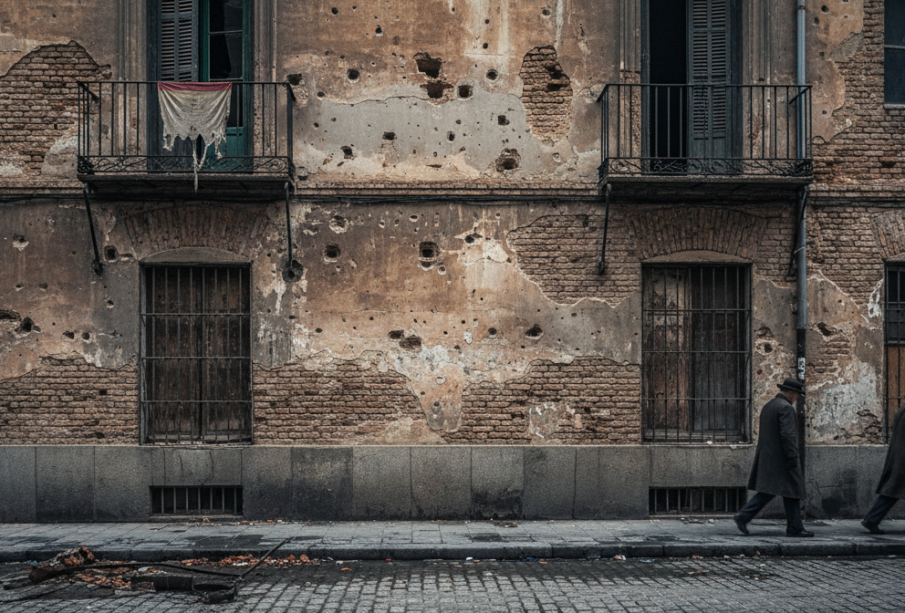
A bitter row has erupted between Madrid’s city council and international photography institutions over plans to transform the site of one of Robert Capa’s most famous Civil War photographs into a youth center rather than a dedicated museum.
A Photograph That Changed History
Nearly 90 years ago, on a winter day in 1936, Robert Capa paused on a street in southeast Madrid to capture an image that would resonate across the globe. The Hungarian-American photojournalist’s lens focused on three children sitting amid rubble outside a shrapnel-scarred house at 10 Peironcely Street in the working-class Vallecas district.
The single-story building behind them bore fresh wounds from Nazi German and Italian bombing raids supporting Francisco Franco’s coup. When the photograph appeared in international press, it not only documented the civilian cost of aerial warfare but also rallied volunteers to the anti-fascist cause. The image, titled ‘Children in Madrid,’ became one of Capa’s most iconic works and a symbol of the Spanish Civil War.
A Decade of Activism Derailed
For ten years, the Save Peironcely 10 platform fought tirelessly to preserve the building and create a dedicated Robert Capa museum. Their efforts successfully relocated 14 families who had been living in cramped, squalid conditions within the historic structure.
But Madrid’s conservative city council, led by Mayor José Luis Martínez-Almeida, has now abandoned previous plans for a standalone Capa museum. Instead, the council announced in February that the site will become the Robert Capa Cultural Experimentation Center – a youth facility scheduled to open in 2028 with a budget of approximately $1.15 million (about 1.05 million euros).
The 4,300-square-foot (400 square meters) center will focus on workshops in visual arts, theater, music, and literature for young people up to 18 years old. Only a small portion will be dedicated to the building’s historical significance and Capa’s role in documenting the war.
International Backlash Threatens Project
The decision has triggered fierce opposition from international photography institutions. The International Centre of Photography (ICP) in New York, which serves as custodian of Capa’s legacy, has taken the extraordinary step of threatening to prohibit the use of the photographer’s name for the project.
In a letter sent to the city council, the ICP stated it ‘will NOT authorise, endorse, or permit the use of Robert Capa’s name, image, or photographic legacy’ for any project at Peironcely 10 that isn’t approved by the Save Peironcely 10 platform. The organization warned that any attempt to associate Capa’s name with the municipal plan would ‘lack international backing and institutional legitimacy.’
The Capa House museum in Leipzig, Germany – established at another site featured in Capa’s famous photographs – had hoped to create a sister relationship with the Madrid location. In their own letter to the council, they described the Madrid house as a potential ‘crown jewel of work for peace and international cooperation.’
Politics and Memory Collide
The controversy reflects deeper tensions about historical memory in contemporary Spain. José María Uría of the trade union Fundación Anastasio de Gracia, who coordinated the platform’s preservation efforts, attributes the policy reversal to changes in the city’s culture department leadership. ‘They’re acting in a kind of rather opaque way,’ he said, describing the decision as a ‘180-degree turn.’
The council has handed management of the project to the José María de Llanos Foundation, a local youth organization named after a prominent priest who worked in Vallecas for decades. While campaigners don’t question the foundation’s social work, they argue that the unique historical significance of Peironcely 10 is being sacrificed.
‘Vallecas needs the José María de Llanos Foundation, but there is only one Peironcely 10 in the world,’ the platform stated. The Spanish government’s Directorate General for Democratic Memory has initiated procedures to declare the site a Place of Memory, which could provide additional protection and pressure the city council to reconsider its approach.
A Legacy Under Threat
The building’s journey from war-torn symbol to potential cultural center reflects broader struggles over how Spain remembers its civil war past. After the conflict ended, the structure remained semi-ruined for nearly a decade before being divided into cramped apartments. The shrapnel holes that made it famous were plastered over, and families lived in poverty within its walls for generations.
Now, as the 2028 opening date approaches, the project’s future remains uncertain. The international photography community’s refusal to authorize Capa’s name could force the council to rebrand entirely, potentially undermining the center’s cultural significance and tourist appeal.
For the residents of Vallecas, the dispute represents more than just institutional politics. It’s about whether their neighborhood’s role in one of the 20th century’s defining conflicts will be properly remembered or reduced to a footnote in a youth program. As one local activist put it, the building represents ‘a unique opportunity’ that, once lost, cannot be recreated anywhere else in the world.


Leave a reply



We bring you daily news from around the world. From technology to lifestyle to design and music.