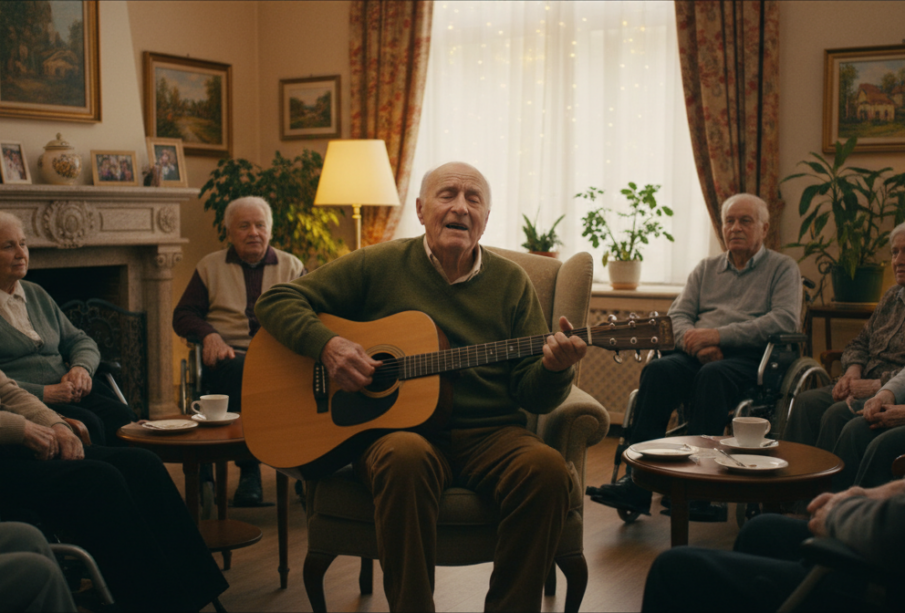
When most people his age are settling into quiet retirement, Franco Trincale is still singing the news – just with a different audience.
From Barber Shop to Street Corner
Picture this: a young barber’s apprentice in 1950s Sicily, humming folk songs between haircuts while his boss strums guitar. Fast-forward seven decades, and that same kid – now 90 – is Italy‘s last great cantastorie, still belting out ballads in a Milan nursing home.
Franco Trincale never planned to become a living piece of history. Born in 1935 in the small Sicilian town of Militello in Val di Catania, he started out cutting hair, not cutting records. But life had other plans. After marrying his beloved Lina and leaving the navy, he tried selling vegetables. When that flopped, he made a decision that would define the next six decades: ‘I’ll be a cantastorie.’
The Medieval Art That Became Modern Journalism
The cantastorie tradition stretches back to medieval troubadours – those wandering poets who sang tales of knights and romance across Europe from the 11th to 13th centuries. But what makes Italian cantastorie unique is their focus on real-life stories, not fairy tales.
Think of them as the world’s first singing journalists. Before TV, before radio, before most people could even read, cantastorie were the CNN of their day. They’d roll into town with guitars, accordions, and massive illustrated posters, turning current events into catchy ballads. A murder? There’s a song for that. Political scandal? Set to music. Natural disaster? Coming right up with a memorable chorus.
By the time Trincale hit Milan‘s streets in 1959, the tradition was already fading. Television was killing the cantastorie just like it killed radio stars. But Trincale adapted, developing what he called ‘giornalismo cantato’ – sung journalism.
The Voice of the Working Class
Trincale‘s breakthrough came outside factory gates. Milan in the 1960s was booming, sucking in thousands of southern Italian migrants looking for work. Traditional cantate (sung tales) lasted hours, but factory workers only had short breaks. So Trincale invented the three-minute news ballad.
Workers loved it. Here was someone singing their stories – contract negotiations, workplace accidents, the daily grind of industrial life. They started writing him letters, sharing their struggles, asking him to put their problems to music. Trincale became their unofficial spokesman, the guy who could ‘capture and denounce a problem in a few minutes,’ as anthropologist Mauro Geraci puts it.
For decades, Trincale was Milan‘s musical memory bank. He sang about the 1970s terrorism, Berlusconi‘s rise, Tangentopoli (Italy’s massive corruption scandals), even the Iraq War. More than 30 albums, performances from the USSR to the US, and a 2008 gold medal from Milan for cultural merit.
Love Songs in the Twilight
Today, Trincale lives at Il Parco delle Cave, an assisted living facility in Milan‘s Baggio district. He moved there in 2024 to be with Lina, his wife of over 60 years, who has Alzheimer’s and can now only communicate with her eyes.
The man who once sang about political corruption and workers’ rights now croons love songs. His voice struggles with the high notes, but residents and their families pack the main hall for his concerts. They help him with the choruses, clapping along to songs like ‘Long Live Love’ – his recent composition for Valentine’s Day.
Trincale‘s room has become a mini-museum, filled with posters, records, and memorabilia from five decades of street performances. The rest of his collection sits in a permanent exhibition back in Militello, his Sicilian hometown.
The End of an Era
When Trincale finally stops singing, a 1,000-year-old tradition dies with him. The cantastorie emerged from medieval Italy’s traveling storytellers, evolved through centuries of social change, and survived everything from the Renaissance to World War II. But they couldn’t survive the internet age.
‘Cantastorie followed current events,’ explains Mauro Geraci, who studies the tradition. They emerged when public opinion was forming, serving as both entertainers and social critics. Trincale was the last to master this balance, turning news into art, politics into poetry.
Now 90, still performing for nursing home residents, Trincale represents something we’ve lost in our digital age: the human voice making sense of the world’s chaos, one song at a time. His story isn’t just about the end of cantastorie – it’s about what happens when ancient arts meet modern life, and somehow, against all odds, keep singing.




Leave a reply



We bring you daily news from around the world. From technology to lifestyle to design and music.