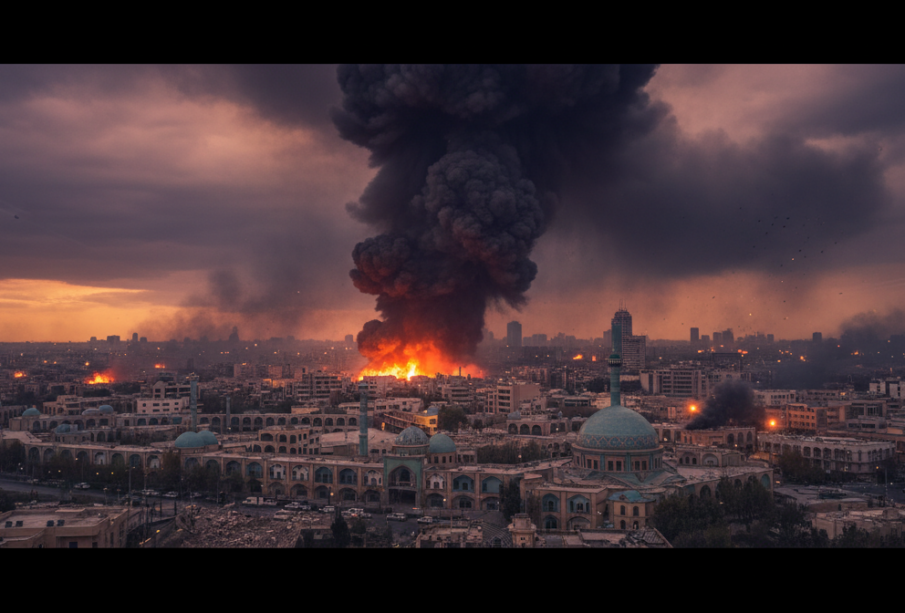
The assassination of Iran’s Supreme Leader Ali Khamenei in joint US-Israeli strikes has triggered an unprecedented succession crisis and regional conflict that’s reshaping the Middle East.
The Strike That Changed Everything
At 8:10 AM Tehran time on February 28, 2026, everything changed for Iran. A joint US–Israeli strike hit the compound of Supreme Leader Ayatollah Ali Khamenei, killing the 86-year-old leader who had ruled the Islamic Republic for nearly four decades.
The attack wasn’t just another military operation – it was a calculated decapitation strike that the CIA had been planning for months. Intelligence sources reveal they’d been tracking Khamenei’s movements, knowing he rarely left his heavily fortified bunker that took over five minutes to reach by elevator. The opportunity came when a high-level meeting was scheduled at his official residence.
President Trump wasted no time claiming victory, calling Khamenei ‘one of the most evil people in History’ on his Truth Social platform. Israeli Prime Minister Netanyahu echoed the sentiment, with his defense minister praising the ‘brilliant execution’ of Operation Roar of the Lion.
A Nation Without Its Supreme Leader
For the first time since 1989, Iran finds itself without a Supreme Leader. The constitutional machinery kicked in immediately, establishing an Interim Leadership Council comprising President Masoud Pezeshkian, Chief Justice Gholam-Hossein Mohseni-Ejei, and Guardian Council member Ayatollah Alireza Arafi.
But this isn’t just about replacing one man. The strikes decimated Iran’s entire power structure, killing over 40 senior officials including Revolutionary Guard commanders, defense chiefs, and even Khamenei’s family members. His daughter, son-in-law, grandchild, and daughter-in-law all perished in the compound attack.
The 88-member Assembly of Experts now faces the monumental task of selecting a new Supreme Leader while the country is literally under fire. Unlike 1989, when Khamenei was chosen within hours of Khomeini’s death, this succession is happening during wartime with no clear heir apparent.
Regional Chaos Unfolds
Iran’s response has been swift and devastating. The Islamic Revolutionary Guard Corps launched what it calls its ‘most-intense offensive operation’ in history, targeting 27 US military bases across the Middle East and striking deep into Israel.
The retaliation has turned the Persian Gulf into a war zone. Explosions rocked Dubai, Doha, Manama, and Riyadh as Iranian missiles and drones found their targets. Dubai’s iconic Burj Al Arab caught fire from intercepted drone debris, while the massive Jebel Ali Port – a critical global shipping hub – was hit by falling wreckage.
Casualties are mounting. At least 201 people have died in Iran, including 148 in a horrific attack on an elementary girls’ school. In Israel, eight people were killed in Beit Shemesh, about 12 miles west of Jerusalem. Three US troops have also been confirmed dead, with Trump vowing to ‘avenge’ their deaths.
The Succession Game
Who will lead Iran next? The betting markets and political analysts are watching several key figures. Mohseni-Ejei, already on the interim council, brings decades of judicial and intelligence experience but carries the baggage of brutal protest crackdowns.
Mojtaba Khamenei, the late leader’s son, has strong Revolutionary Guard connections but faces resistance from clerics who oppose dynastic succession. Hassan Khomeini, grandson of the revolution’s founder, offers symbolic legitimacy but has been sidelined by hardliners for years.
The wild card is Alireza Arafi, the 67-year-old cleric now serving on the interim council. As deputy chairman of the Assembly of Experts and head of Iran’s seminary system, he has the religious credentials and institutional backing that others lack. Some sources suggest he was already on Khamenei’s secret shortlist of potential successors.
What Comes Next
Trump has made his intentions clear: regime change in Iran. He’s called on Iranians to ‘take over your government’ once the bombing stops, betting that Khamenei’s death will trigger popular uprisings.
But early signs suggest the opposite. Massive pro-government rallies have filled Tehran’s streets, with mourners carrying Khamenei’s portrait and chanting ‘Death to America.’ The regime has declared 40 days of national mourning and is projecting defiance despite the ongoing strikes.
The economic implications are staggering. Oil prices have surged nearly 20% year-to-date as shipping routes through the Persian Gulf face disruption. Marine insurance rates in the Gulf could jump 25-50%, while major airlines have suspended flights across the region.
As Trump promises the bombing will continue ‘four weeks or less,’ the Middle East braces for its most significant transformation since the Arab Spring. Whether Iran emerges stronger or collapses entirely may depend on who the Assembly of Experts chooses to lead them through this unprecedented crisis.

Leave a reply



We bring you daily news from around the world. From technology to lifestyle to design and music.