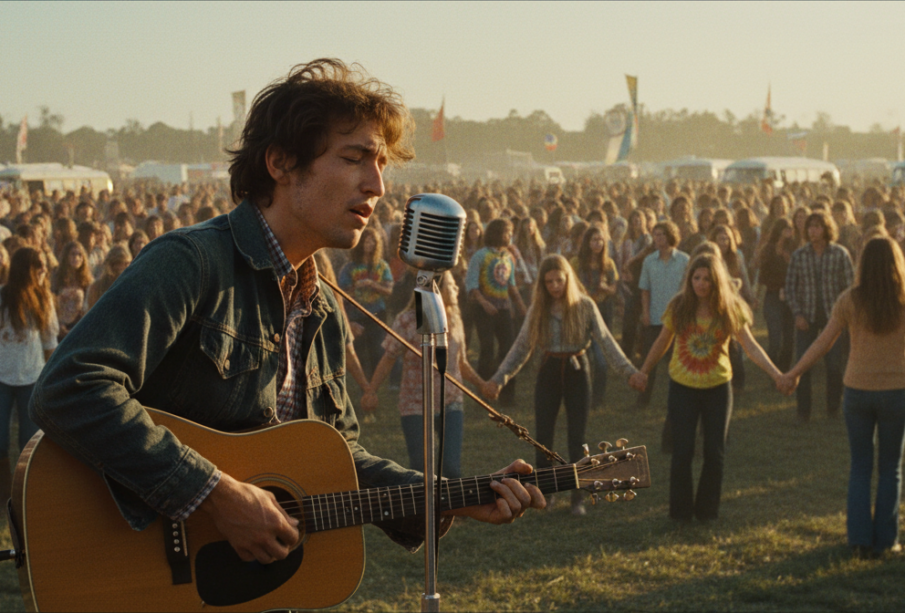
The psychedelic folk-rock pioneer who delivered one of Woodstock’s most memorable performances with his anti-war anthem passed away Saturday in Berkeley from Parkinson’s complications.
A Voice of Rebellion Falls Silent
Country Joe McDonald, the counterculture icon whose defiant anti-Vietnam War anthem became a defining moment of the 1969 Woodstock Festival, died Saturday at age 84. The singer-songwriter passed away in Berkeley, California, following complications from Parkinson’s disease, according to his wife Kathy and the band’s official statement.
Born Joseph Allen McDonald on January 1, 1942, in Washington, D.C., he became the voice of a generation questioning authority and war. His most famous song, ‘I-Feel-Like-I’m-Fixin’-to-Die Rag,’ written in just under an hour in 1965, transformed from a simple protest tune into a cultural phenomenon that still resonates today.
The Fish Cheer That Shocked America
McDonald’s legendary Woodstock performance wasn’t just about the music—it was about the moment he led nearly 500,000 festival-goers in spelling out the F-word before launching into his signature anti-war song. What started as the innocent ‘F-I-S-H’ cheer for his band Country Joe and the Fish evolved into something far more provocative.
‘Some people alluded to peace and stuff at Woodstock, but I was talking about Vietnam,’ McDonald told the Associated Press in 2019. The cheer became ‘an expression of our anger and frustration over the Vietnam war, which was killing us, literally killing us.’
That single performance brought both fame and consequences. Ed Sullivan cancelled the band’s planned appearance on his variety show in 1968 after learning about the explicit cheer. McDonald was even arrested and fined for using it at a show in Worcester, Massachusetts—an ordeal that helped accelerate the band’s eventual breakup in 1970.
From Navy Service to Anti-War Activism
The irony wasn’t lost on McDonald that his most famous anti-war song came from someone who had served his country. He enlisted in the U.S. Navy as a teenager, spending three years stationed in Japan from 1959 to 1962. This military experience gave weight to his later protests against the Vietnam War.
After returning to California, McDonald immersed himself in the Bay Area‘s burgeoning folk scene. In 1965, he co-founded Country Joe and the Fish with guitarist Barry ‘The Fish’ Melton in Berkeley. The band quickly became fixtures alongside legendary acts like the Grateful Dead, Jefferson Airplane, and Quicksilver Messenger Service.
Beyond the Protest Song
While ‘I-Feel-Like-I’m-Fixin’-to-Die Rag’ defined McDonald’s public image, his artistic output was far more extensive. He recorded 33 albums over a 60-year career, writing hundreds of songs that addressed everything from environmental issues to civil rights. His 1982 release ‘Save the Whales’ demonstrated his continued commitment to activism beyond the Vietnam era.
McDonald’s influence extended into the courtroom as well. In January 1970, he testified at the infamous Chicago Seven Trial, where he was forbidden by the judge from singing his protest song. Undeterred, he recited the lyrics instead, cementing his reputation as an uncompromising voice of dissent.
Despite his anti-war stance, McDonald showed remarkable nuance in later years. In the 1990s, he helped organize the construction of a Vietnam veterans memorial in Berkeley. ‘Many remembered the ugly confrontations that had happened during the war years in the city,’ he later wrote. ‘Yet the atmosphere proved to be one of reconciliation, not confrontation.’
A Legacy That Transcends Generations
McDonald’s impact on American culture extended far beyond music. He published a left-leaning magazine called Rag Baby, which combined political writing with satirical commentary. His activism continued through organizations like Vietnam Veterans Against War and Swords to Plowshares.
Reflecting on his career in 2016, McDonald said, ‘I find the concept of 50 years incomprehensible. But it’s indisputable because I have children and some of those children have children.’ He remained active until the end, continuing to perform and record well into his eighties.
McDonald is survived by his wife of 43 years, Kathy, five children—Seven, Devin, Tara Taylor, Emily, and Ryan—and four grandchildren. While no public memorial is planned at this time, his musical legacy ensures that his voice of protest will continue to inspire future generations questioning authority and fighting for peace.




Leave a reply



We bring you daily news from around the world. From technology to lifestyle to design and music.