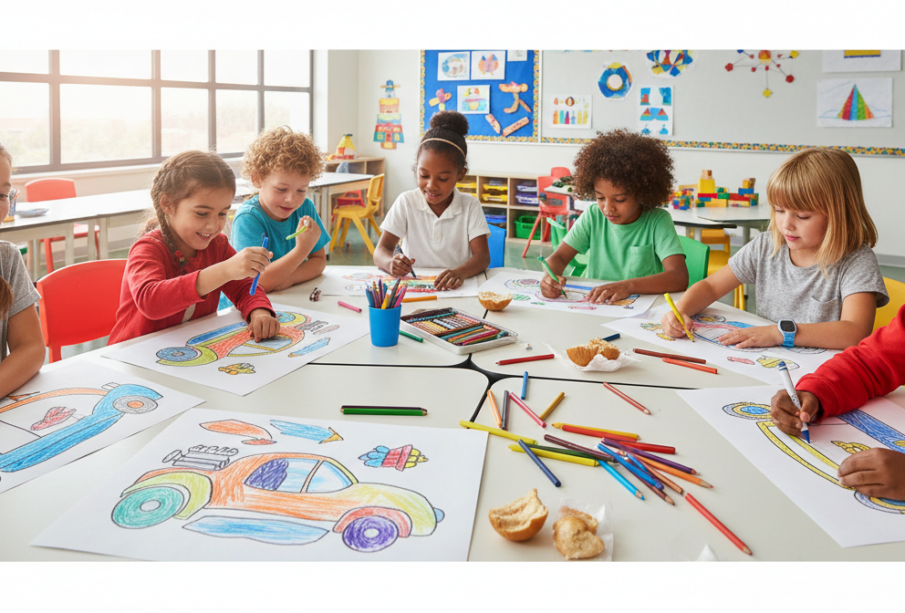
Toyota launches its 19th annual Dream Car Art Contest, inviting children under 15 to imagine the future of mobility through art. With submissions from over 90 countries expected, the global competition continues to inspire young minds to envision tomorrow’s transportation.
A Canvas for Tomorrow’s Mobility
What if a seven-year-old could design the car that saves our planet? That’s exactly the kind of thinking Toyota wants to unleash with the launch of its 19th Dream Car Art Contest. This global initiative, which began accepting submissions in January 2026, invites children aged 15 and under to draw their vision of future transportation.
The contest operates on a beautifully simple premise: give kids crayons, markers, or digital tools, and ask them to imagine ‘Your Dream Car.’ No corporate boardrooms, no focus groups – just pure, unfiltered creativity from the minds that will inherit our world. Since its inception in 2004, this competition has collected nearly 9.4 million submissions from 144 countries and regions, creating what might be the world’s largest repository of childhood dreams about mobility.
What makes this contest particularly fascinating is how it reveals children’s priorities. Past winners have designed cars that clean pollution, vehicles that bring medicine to remote areas, and automobiles that literally spread happiness. These aren’t just drawings – they’re blueprints for a better world, sketched in colored pencil.
The Global Race for Recognition
The competition unfolds in two distinct phases, each with its own stakes and rewards. First comes the national contest, where children compete within their home countries across three age categories: 7 years and under, 8-11 years, and 12-15 years. Winners receive prizes ranging from skateboards and LEGO sets to electronic gadgets, but more importantly, they earn the chance to represent their nation on the global stage.
The real excitement builds toward the World Contest held in Japan, where national champions face off against the planet’s most creative young minds. Here, the judging criteria become more sophisticated, evaluating not just artistic skill but also the originality of the concept and the story behind each drawing. Financial prizes await the global winners, along with recognition that could inspire a lifetime of innovation.
This year’s contest has already attracted impressive participation. Malaysia alone received over 3,200 submissions in the previous edition, while the global total reached 665,326 entries from 90 countries. These numbers represent more than statistics – they showcase a generation actively engaged in solving tomorrow’s transportation challenges.
Rules, Deadlines, and Digital Dreams
The technical requirements strike a balance between accessibility and quality. Traditional hand-drawn artwork must be created on paper no larger than 15.7 by 21.7 inches, with A3 size preferred. Digital submissions are equally welcome, requiring files between 1-5 MB with 300 DPI resolution in JPG or PNG format. Importantly, digital artwork means original digital creation, not scanned hand drawings.
Deadlines vary by country, but most national contests close by late February 2026. Czech Republic accepts submissions until February 28, 2026, while India’s window runs from January 12 to February 12, 2026. The staggered timeline allows for thorough national judging before the global competition begins.
One crucial rule governs all submissions: the artwork must be entirely the child’s own creation. No adult assistance, no AI generation, no collaborative efforts. This isn’t just about fairness – it’s about preserving the authentic voice of childhood imagination. As Jitka Jechová, head of communications for Toyota Czech Republic, explains, the contest values not just artistic ability but ‘the idea itself and the overall story that is always connected with the picture.’
Beyond Competition: Inspiring Innovation
The contest’s deeper purpose extends far beyond awarding prizes. Toyota positions this initiative as part of its mission to ‘Produce Happiness for All,’ recognizing that today’s young artists might become tomorrow’s engineers, designers, and innovators. The company believes creativity drives progress, and these childhood visions could genuinely influence future vehicle development.
Consider the broader implications: children who imagine cars powered by kindness or vehicles that plant trees while driving aren’t just being fanciful – they’re identifying real-world problems and proposing solutions. Their drawings reveal priorities that adult designers might overlook, from environmental concerns to social justice issues.
The contest results will unfold throughout 2026, with national winners announced in March and April, followed by the global championship in August. But perhaps the real victory lies not in individual prizes but in the collective imagination of nearly a million young minds working toward a better future. In a world often focused on limitations, the Toyota Dream Car Art Contest celebrates the boundless possibility that emerges when we ask children a simple question: ‘What if?’

Leave a reply



We bring you daily news from around the world. From technology to lifestyle to design and music.