The Ticking Clock Above Our Heads
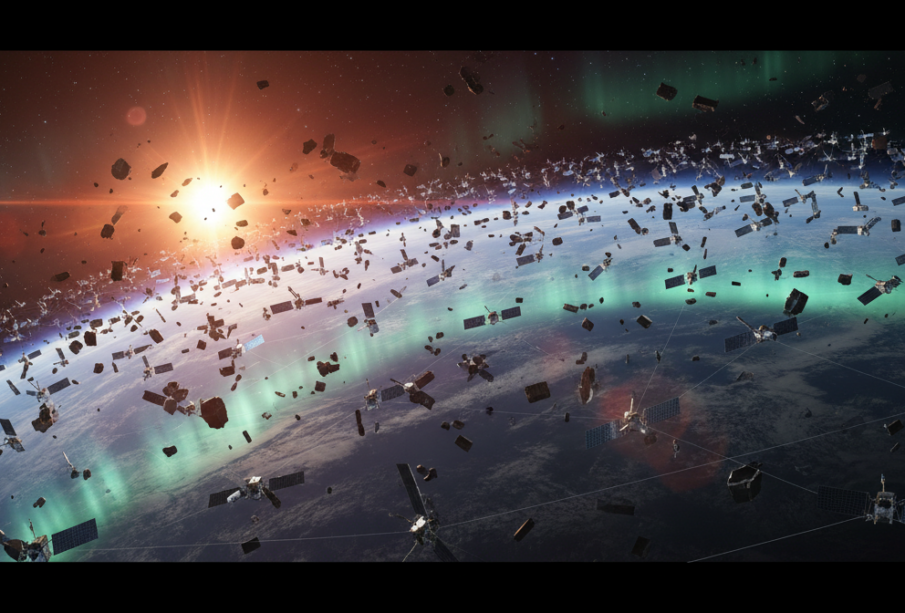
Scientists have created a countdown timer that reveals a terrifying truth: if satellites lose control during a solar storm, we have just 2.8 days before catastrophic collisions begin.
A House of Cards in Space
Picture this: every 22 seconds, two satellites pass within less than one kilometer of each other in the crowded highways of low Earth orbit. It’s a cosmic ballet performed at breakneck speed, where over 9,400 Starlink satellites alone circle our planet, making up 65% of all active satellites. What was once a vast, empty frontier has become a bustling metropolis of metal and silicon.
This isn’t just about numbers. Sarah Thiele, originally a PhD student at the University of British Columbia and now at Princeton, calls our current satellite system a “house of cards.” It’s a perfect metaphor for something that looks impressive but could collapse at any moment. The question isn’t if something will go wrong, but when.
When the Sun Throws a Tantrum
Solar storms aren’t just pretty light shows in the sky. They’re cosmic hurricanes that can wreak havoc on our carefully orchestrated satellite dance. During the May 2024 “Gannon Storm,” more than half of all satellites in low Earth orbit had to use up some of their fuel to reposition themselves.
Here’s the scary part: solar storms can heat and expand Earth’s upper atmosphere, making satellites encounter more drag. Imagine trying to drive in a sudden fog where you can’t see where other cars are, and your steering becomes unpredictable. That’s what happens to satellites during these storms. Solar storms can interfere with, degrade, or knock out navigation and communications, leaving operators blind and helpless.
The CRASH Clock Countdown
Scientists have developed something called the Collision Realization And Significant Harm (CRASH) Clock. Think of it as a doomsday timer, but for space. The current reading is 2.8 days – that’s how long we have before the first collision if satellites suddenly lose their ability to maneuver.
To put this in perspective, in 2018, before the megaconstellation era, the CRASH Clock was 121 days. We’ve gone from having four months to fix problems to having less than three days. Within 24 hours of losing control, there’s a 30% chance of a collision between two catalogued objects and a 26% chance involving a Starlink satellite.
The Carrington Event Shadow
The 2024 storm was impressive, but it wasn’t even close to the worst we’ve seen. The Carrington Event of 1859 was the strongest solar storm on record, and if a similar event happened today it would wipe out our ability to control satellites for much longer than 3 days.
A single event could wipe out our satellite infrastructure and leave us Earth-bound for the foreseeable future. No GPS navigation, no satellite internet, no weather forecasting from space. It’s not science fiction – it’s a documented historical event that could happen again tomorrow.
Living on Borrowed Time
A major collision would be more like the Exxon Valdez oil spill disaster than a Hollywood-style immediate end of operations in orbit. Satellite operations could continue after a major collision, but would have different operating parameters, including a higher risk of collision damage.
The researchers aren’t trying to scare us into abandoning space. Mega-constellations bring real benefits: global connectivity, redundancy, new services, and a reshaped space economy. The point isn’t to deny those benefits, but to underline that the system’s stability now depends on continuous, high-quality control in an environment where rare but severe disruptions are part of reality.
We’re not doomed, but we’re definitely walking a tightrope. The CRASH Clock isn’t predicting the end of the world – it’s giving us a wake-up call about how fragile our space-based civilization has become.




Leave a reply



We bring you daily news from around the world. From technology to lifestyle to design and music.