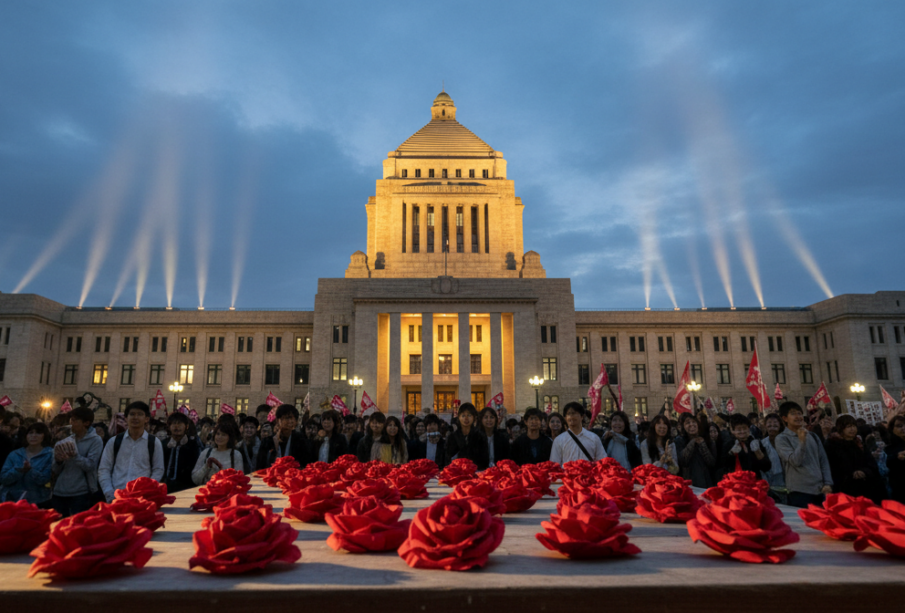
Japan’s first female prime minister gambled everything on a snap election — and won the biggest single-party victory since World War II, powered by viral youth fandom and a $900 handbag.
The Gamble That Broke the Record Books
Three months. That’s how long Sanae Takaichi waited before rolling the dice on her entire political career. On February 8, 2026, Japan’s first female prime minister called a snap election that nobody saw coming — and walked away with the most dominant single-party victory in the country’s postwar history.
Her Liberal Democratic Party (LDP) grabbed 316 of 465 seats in the lower house, smashing the supermajority threshold of 310 and obliterating the previous record of 300 seats set back in 1986. Together with coalition partner Japan Innovation Party (JIP), the ruling bloc now holds 352 seats — roughly three-quarters of the entire chamber. To put it bluntly: the opposition got decimated. The hastily formed Centrist Reform Alliance, a merger of the old Constitutional Democratic Party and Komeito, was left with a pitiful 49 seats.
Takaichi had publicly vowed to resign if her coalition lost its majority. Instead, she delivered a result that gives her the power to override the upper house, chair every lower house committee, and potentially push through constitutional amendments. It’s the kind of mandate most leaders only dream about.
The Sanamania Effect
Here’s the part that makes this story genuinely wild. The 64-year-old conservative leader didn’t win by playing it safe with the usual gray-suited establishment playbook. She won because young voters are obsessed with her.
The phenomenon has a name: ‘sanakatsu,’ or ‘Sanamania’ — a playful twist on ‘oshikatsu,’ the Japanese word for obsessive pop-culture fandom. Pre-election polls showed her approval among voters under 30 at a staggering 90 percent. Her overall approval sat around 60 percent, which is already remarkable by Japanese standards. She has 2.6 million followers on X, nearly five times the following of her predecessor Shigeru Ishiba.
But the fandom goes way beyond likes and retweets. The $900 black leather handbag she carries — made by a company called Hamano — is sold out with a nine-month waiting list, and the buyers are mostly in their twenties and thirties. Her pink ballpoint pen went viral. Even a bag of shrimp rice crackers she was spotted holding on a train became a must-have item. It’s the kind of consumer mania you’d expect around a K-pop star, not a prime minister.
Motorbikes, Metal Drums, and Margaret Thatcher
So who exactly is Sanae Takaichi? She’s a motorbike-riding, heavy metal-drumming conservative who cites Margaret Thatcher as her inspiration. The daughter of a police officer and a car company worker, she grew up far from Japan’s political elite. Her campaign slogan — ‘work, work, work, work and work’ — was named the country’s catchphrase of the year.
She made headlines in January when she sat down for an impromptu drum session with South Korean President Lee Jae-myung, playing a K-pop track. She took selfies with Italian PM Giorgia Meloni. And she hit it off with President Trump so well that he gave her his ‘complete and total endorsement’ days before the election — something U.S. presidents almost never do for foreign candidates.
But don’t let the viral moments fool you. Beneath the charisma sits a deeply conservative agenda. Takaichi opposes same-sex marriage, supports male-only imperial succession, and has only two women in her cabinet. She’s pushing to revise Japan’s pacifist constitution and dramatically boost military spending. In November, she broke decades of diplomatic ambiguity by telling parliament that a Chinese attack on Taiwan — just 60 miles from Japanese territory — could trigger a Japanese military response. China retaliated by canceling flights and restricting seafood imports.
Sanaenomics: Big Spending, Big Questions
On the economic front, Takaichi is charting her own course with what analysts are calling ‘Sanaenomics.’ Her government just passed a record-breaking budget of ¥122 trillion (approximately $783 billion), and she’s proposed freezing the food consumption tax for two years — a move that rattled bond markets.
The spending plans are ambitious: strategic investments in AI, quantum computing, infrastructure, and defense. She’s framing it as economic security. But critics are already asking the obvious question: where does the money come from? Japan is already the most indebted developed nation on earth. Fully eliminating the food tax alone would cost about ¥5 trillion (roughly $33 billion) annually.
Still, the Tokyo stock market loved the result. The Nikkei 225 surged more than 5% after the election, hitting a fresh intraday high on expectations of tax cuts and higher government spending.
What Comes Next
With this mandate, Takaichi won’t face another national election until the upper house poll in 2028. That’s a lot of runway. She’s already confirmed a White House visit scheduled for March 19, where trade and security deals with the U.S. will top the agenda.
The geopolitical implications are massive. Her Taiwan comments have put Japan on a collision course with Beijing, and a strong mandate could accelerate her plans to rewrite the country’s defense posture. China’s foreign ministry wasted no time issuing a warning after the election, describing the results as reflecting ‘deep-seated structural issues’ and urging Tokyo to retract Takaichi’s remarks.
Meanwhile, smaller parties on the far right also made gains. The nationalist Sanseito party jumped from 2 seats to 15, and the newcomer Team Mirai won 11 seats from zero. Japan’s political center of gravity is shifting rightward, and Takaichi is both the cause and the beneficiary.
The Bigger Picture
There’s something almost cinematic about this story. A woman who spent decades climbing through one of the world’s most male-dominated political systems finally reaches the top — and then, instead of playing it safe, bets everything on a snap election that could have ended her career in three months flat.
As one analyst put it, ‘the power of her personality seems to be transcending politics.’ Whether that personality can translate into actual policy results — tackling inflation, an aging population, a weak yen, and a hostile neighbor across the East China Sea — is the question that will define her legacy. For now, though, Takaichi isn’t just Japan’s iron lady. She’s the most powerful leader the country has seen in generations.




Leave a reply



We bring you daily news from around the world. From technology to lifestyle to design and music.