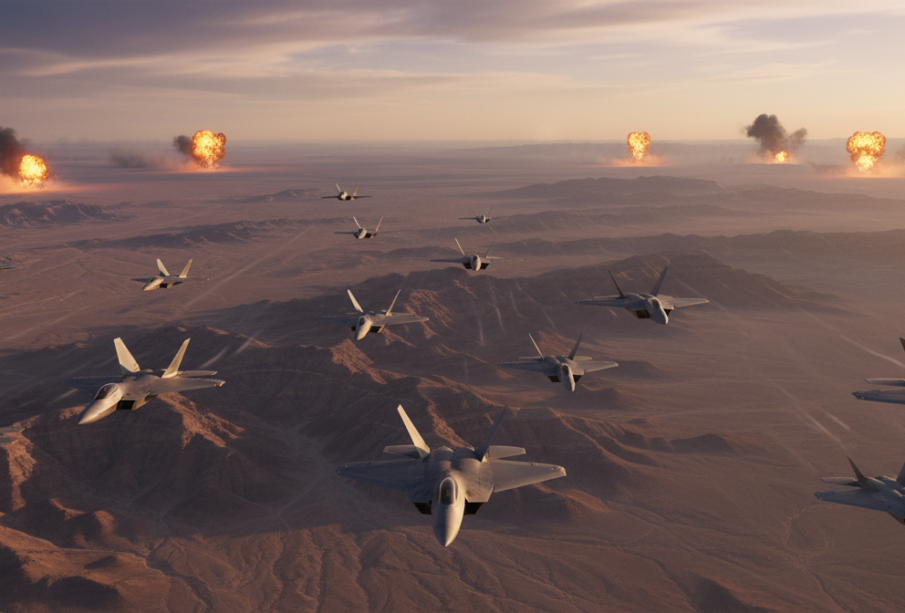
President Trump announced ‘major combat operations’ against Iran on Saturday, claiming Iranian Supreme Leader Khamenei was killed, while Pakistan and Afghanistan declared ‘open war’ following deadly cross-border strikes.
Operation Epic Fury: Trump’s Gamble in Iran
The Middle East witnessed its most dramatic escalation in years as President Trump announced what he called ‘major combat operations’ against Iran early Saturday morning. The coordinated assault with Israel, dubbed ‘Operation Epic Fury,’ began around 1 a.m. Eastern time with Tomahawk cruise missiles and airstrikes targeting Iranian military installations.
In a video posted to his Truth Social platform, Trump declared his objective was to ‘defend the American people by eliminating imminent threats from the Iranian regime.’ The operation represents a stunning reversal for a president who campaigned on avoiding ‘forever wars’ but now finds himself launching what appears to be a regime-change operation.
The strikes targeted Iran’s missile program, naval assets, and nuclear facilities across multiple provinces. Trump told reporters he wanted to ‘destroy their missiles and raze their missile industry to the ground,’ adding ominously that it would be ‘totally obliterated.’ Israeli forces conducted what military officials described as the largest air operation in the country’s history, with 200 fighter jets hitting 500 targets.
Death of a Supreme Leader
The most explosive claim came Saturday evening when Trump announced that Iranian Supreme Leader Ayatollah Ali Khamenei had been killed in the strikes. ‘He was unable to avoid our Intelligence and Highly Sophisticated Tracking Systems,’ Trump posted, claiming other Iranian leaders were also eliminated.
Israeli sources told media outlets they were ‘99% sure’ Khamenei was dead, though Iran’s Foreign Minister Abbas Araghchi disputed the claim, telling NBC that the Supreme Leader was alive ‘as far as I know.’ No public evidence of Khamenei‘s death has surfaced, and Iranian state media continues to deny the assertion.
The reported assassination, if confirmed, would create a massive power vacuum in Iran. Khamenei had ruled for over three decades with final authority on all major policies. The absence of a clear successor could plunge the Islamic Republic into internal chaos even as it faces external military pressure.
Iran Strikes Back Across the Region
Iran responded swiftly with retaliatory strikes across the Middle East. Iranian missiles targeted Israel, while other strikes hit U.S. military installations in Kuwait, Jordan, the UAE, and Qatar. Air raid sirens wailed across Israel as the Iron Dome intercepted dozens of incoming projectiles.
The Iranian Red Crescent reported more than 200 people killed and roughly 700 injured in the initial U.S.-Israeli assault. Particularly tragic was a strike on a girls’ elementary school in Minab, which drew international condemnation. Iranian officials declared all Israeli and American interests in the region ‘legitimate targets.’
Explosions were reported in Tehran, Qom, Kermanshah, and other Iranian cities. State television broadcast footage of smoke rising from the capital, though the full extent of damage remains unclear. The strikes mark the second time in eight months that the Trump administration has attacked Iran during nuclear negotiations.
Pakistan and Afghanistan: From Neighbors to Enemies
As the Iran crisis unfolded, another conflict exploded along the Afghanistan-Pakistan border. What began with Pakistani airstrikes on February 21st has escalated into what Pakistan‘s Defense Minister Khawaja Asif declared ‘open war’ between the two nations.
The latest round began when Pakistani forces bombed alleged militant camps in Afghanistan’s Nangarhar, Paktika, and Khost provinces, killing 18 civilians including 11 children according to Afghan officials. Pakistan claimed it targeted camps belonging to the Pakistani Taliban (TTP) and ISIS-K, killing 80 militants.
Afghanistan‘s Taliban government retaliated with coordinated attacks on Pakistani border posts. Taliban officials claimed their forces killed 55 Pakistani soldiers and captured multiple military positions, though Pakistan disputes these figures. The fighting has now spread to major Afghan cities, with Pakistani jets bombing Kabul, Kandahar, and Paktia.
International Calls for Restraint Fall on Deaf Ears
The European Union issued urgent appeals for both conflicts to end, warning that continued escalation ‘could have serious consequences for the region.’ UN Secretary-General António Guterres condemned all military actions, stating during an emergency Security Council meeting that ‘we are witnessing a grave threat to international peace and security.’
But diplomatic efforts appear overwhelmed by the pace of military escalation. The Afghanistan-Pakistan conflict centers on Pakistan‘s accusations that the Taliban harbors TTP militants who launch attacks across the border. Despite a Qatar-mediated ceasefire in October 2025, tensions never fully subsided.
In Washington, Congress remains divided over Trump‘s Iran operation. Republicans largely support the strikes, with Senate Majority Leader John Thune praising the president for ‘taking action to thwart threats.’ Democrats criticized the lack of congressional authorization, with House Minority Leader Hakeem Jeffries arguing Trump had ‘abandoned diplomacy’ and left American troops vulnerable to retaliation.
As bombs continue falling across the region, the consequences of these simultaneous conflicts remain unpredictable. What began as separate border disputes and nuclear negotiations has exploded into a multi-front crisis that could reshape the Middle East for generations.

Leave a reply



We bring you daily news from around the world. From technology to lifestyle to design and music.