Digital Time Machine Brings Lost WWII Base Back to Life
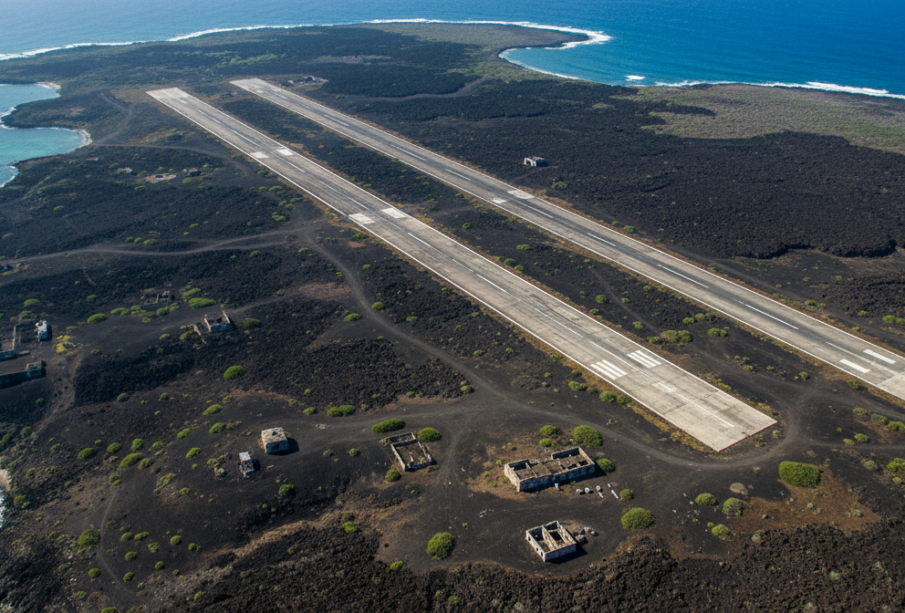
Scientists used cutting-edge technology to reconstruct a forgotten World War II military base in the Galapagos Islands. Only 3% of the original structures remain, but digital archaeology has brought the entire complex back to life.
The Rock That Time Forgot
After Pearl Harbor, the U.S. government selected Baltra Island in the Galapagos for its strategic location and flat terrain. By 1941, the Navy Construction Battalion had built a massive complex with two runways, fuel tanks, pontoon docks, and over 200 buildings including barracks, offices, hangars, a theater, and even a beer garden. The base housed over 3,000 servicemen who nicknamed it “The Rock” because of the volcanic outcrops everywhere. When the war ended in 1946, most facilities were abandoned or dismantled. Some buildings were shipped to other islands, while U.S. equipment was either returned home or tossed into the sea.
Vanished Without a Trace
Today, less than 3 percent of the original 660 mapped rooflines remain on Baltra. With only 18 rooflines still visible, the once-massive military installation has almost completely disappeared. The site now serves as Ecuador’s military installation and civilian airport, making it the main gateway for tourists visiting the Galapagos Islands. What was once a bustling wartime city has been reclaimed by time and nature, leaving behind only fragments of its remarkable history.
Bringing History Back From the Dead
A team of researchers created a groundbreaking 3D digital reconstruction of the base using photogrammetry, remote sensing, and archaeological research. They digitized historical aerial photographs and maps, reviewed archival documentation, and processed remote sensing data. The technique combines photogrammetry with remote sensing to create a “theoretical and methodological bridge between physical traces of past human activity and their contemporary representation.” Advanced methods like multispectral analysis, LiDAR, and synthetic aperture radar help identify subsurface structures and reconstruct past landscapes.
Revolutionary Archaeological Method
“Using historic aerial photography to reconstruct infrastructure has not been done at this scale before,” the research team explained. When combined with GIS-based analysis, these methods allow researchers to visualize and quantify changes in human-environment interactions over time. Photogrammetry has brought significant advances to archaeology, with the main increase in this field observed since 2010, especially with UAVs reducing the cost of photogrammetric flights. The technology enables accurate documentation of objects from small artifacts to entire sites, using standard cameras to create stunning 3D models.
A Window Into the Past
The reconstruction reveals a “vast occupation” of the relatively small island, covering about a quarter of a square mile when the base was active. The digital basemap offers a “unique opportunity to travel back in time through historical aerial photography.” This project demonstrates how modern technology can preserve and reveal lost chapters of history. The Baltra base may have vanished from the landscape, but thanks to digital archaeology, future generations can explore this forgotten piece of World War II history in remarkable detail. It’s a powerful reminder that even when physical structures disappear, the stories they tell can live on through innovative scientific methods.




Leave a reply



We bring you daily news from around the world. From technology to lifestyle to design and music.