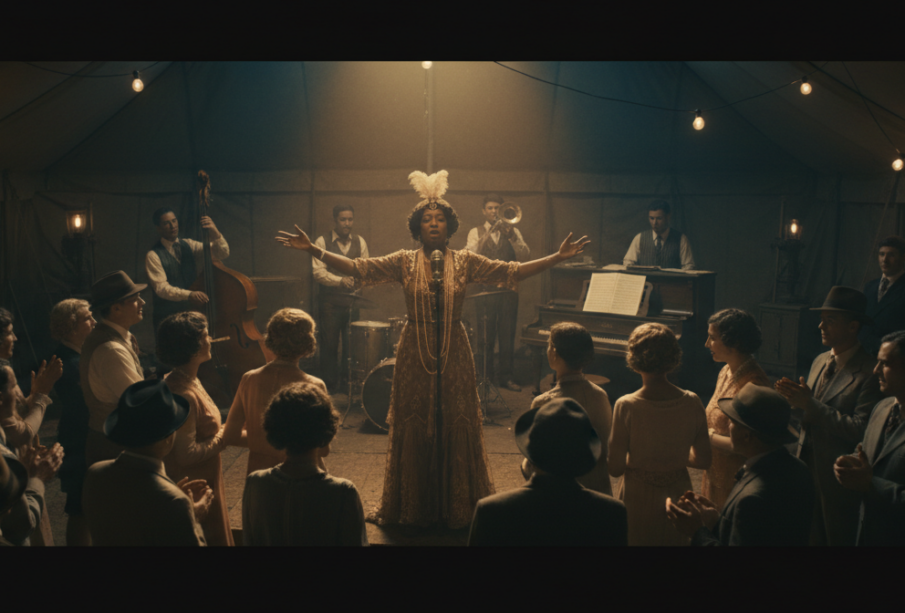
A groundbreaking BBC Radio 3 series is rewriting the story of legendary blues singer Bessie Smith, revealing how she used her music as a weapon against racism and stood up to the Ku Klux Klan in a moment of extraordinary bravery.
Beyond the Legend
The story we think we know about Bessie Smith is only half the truth. Sure, she was the ‘Empress of the Blues,’ a powerhouse performer who sold hundreds of thousands of records in the 1920s. But a new BBC Radio 3 series called ‘Full Moon on Progress Street’ is peeling back the layers of popular mythology to reveal something far more compelling: a woman who used her art as activism, her stage as a battleground, and her voice as a weapon against injustice.
Dr. Rommi Smith, the academic and poet behind this five-part series, isn’t interested in rehashing the same old stories. She’s digging deeper, examining how Smith and four other Black female artists – Sarah Vaughan, Ma Rainey, Abbey Lincoln, and Josephine Baker – shaped the civil rights movement through their music. It’s a radical reframing that puts these women where they belong: at the center of American social change.
The Night She Faced Down Terror
Picture this: a sweltering July night in 1927 in Concord, North Carolina. Bessie Smith is performing under a canvas tent when half a dozen hooded members of the Ku Klux Klan appear, intent on collapsing the tent and terrorizing the crowd. What happened next has become the stuff of legend, but it’s grounded in documented fact.
Smith didn’t cower. She didn’t flee. Instead, she marched outside, drew herself up to her full six feet, and confronted the Night Riders head-on. According to witnesses, she shook her fist at them and ordered them off her property with such force and fury that they actually retreated. Then she calmly walked back into the tent and finished her show.
This wasn’t just personal courage – it was a calculated act of resistance. In an era when the KKK claimed between four and five million members nationwide, when Jim Crow laws were in full effect, and when lynchings were a constant threat, Smith’s defiance was nothing short of revolutionary.
Music as Resistance
Dr. Rommi Smith’s research reveals how Bessie Smith embedded resistance into her very repertoire. Songs like ‘Nobody in Town Can Bake a Sweet Jelly Roll Like Mine,’ ‘I’ve Been Mistreated and I Don’t Like It,’ and ‘Devil’s Gonna Get You’ weren’t just entertainment – they were statements of defiance, declarations of independence from a society that wanted to keep Black women silent and subservient.
The series explores how Smith’s traveling shows were themselves acts of rebellion. When segregation laws prevented her from traveling first-class, she didn’t accept second-class treatment. Instead, she bought her own custom Pullman car – a two-story mobile palace painted bright yellow with green lettering that announced her arrival in every town. It had seven staterooms, a kitchen, and a bathroom, housing her entire troupe in luxury that many white performers couldn’t afford.
The Scholar Behind the Story
Dr. Rommi Smith brings unique credentials to this project. She’s not just an academic – she’s the inaugural British Parliamentary Writer-in-Residence, a three-time BBC Writer-in-Residence, and a judge for the 2025 Forward Prizes for Poetry. Her work spans from collaborating with composer Roderick Williams on pieces commemorating Dr. Martin Luther King Jr. to creating performance works for the Institute of Contemporary Art.
Her academic research focuses specifically on jazz, blues, women, and civil rights – making her perfectly positioned to uncover the political dimensions of these artists’ work. She’s interviewed contemporary musicians from Dr. Dianne Reeves to Dr. Esperanza Spalding, understanding how the legacy of artists like Bessie Smith continues to influence performers today.
Rewriting History
What makes this series revolutionary is its refusal to separate art from activism. Too often, we’ve been told that entertainers like Bessie Smith were ‘just’ singers, that their political impact was incidental. Dr. Rommi Smith’s research proves otherwise.
Smith’s confrontation with the KKK wasn’t an isolated incident – it was part of a pattern of resistance that ran through her entire career. Her music gave voice to the experiences of working-class Black women at a time when their stories were largely ignored. Her success proved that Black artistry could command respect and serious money, paving the way for generations of performers.
The series, produced by Polly Thomas for BBC Radio 3, represents a new kind of cultural scholarship – one that recognizes these women not as footnotes to history, but as architects of change. In an era when we’re still fighting many of the same battles Bessie Smith faced, her story feels more relevant than ever.




Leave a reply



We bring you daily news from around the world. From technology to lifestyle to design and music.