When AI Meets Reality: Thousands Duped by Fake Brooklyn Bridge Fireworks Show
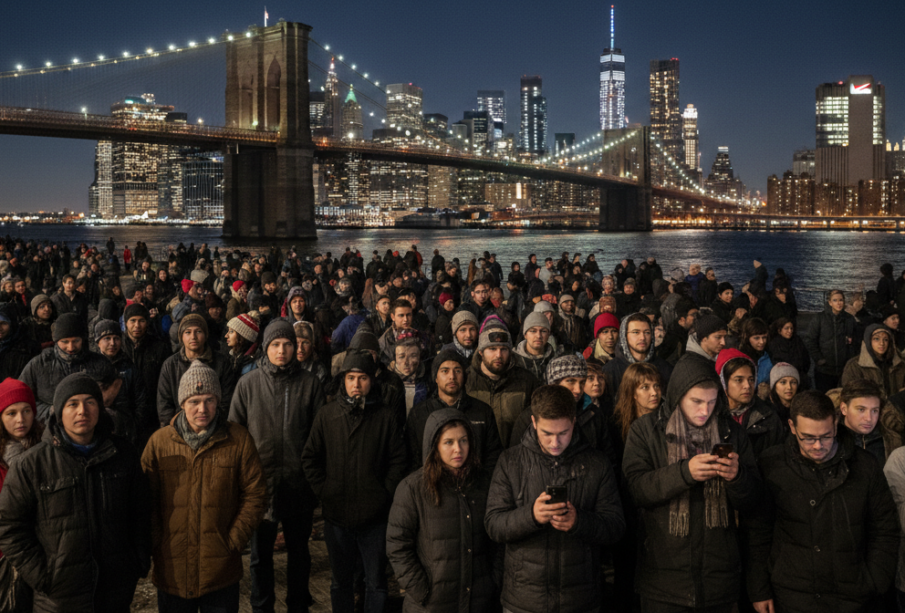
Thousands of New Yorkers and tourists stood in freezing temperatures on New Year’s Eve, waiting for spectacular fireworks at the Brooklyn Bridge that never existed—all thanks to convincing AI-generated videos and social media misinformation.
Picture this: You’re standing in 25-degree weather at midnight on New Year’s Eve, surrounded by thousands of people, phones raised to capture what was promised to be an epic fireworks display over the Brooklyn Bridge. The countdown begins. Ten, nine, eight… and then nothing. Complete silence. No fireworks. No explanation. Just the cold realization that you’ve been had.
This exact scenario played out on January 1, 2026, when thousands of people gathered at Brooklyn Bridge Park and the surrounding DUMBO waterfront, convinced they were about to witness a spectacular New Year’s Eve fireworks show. The problem? No such event was ever planned.
The culprit behind this mass deception wasn’t a traditional prankster or even human error—it was artificial intelligence. In the days leading up to New Year’s Eve, AI-generated videos flooded social media platforms like TikTok and Instagram, showing dramatic fireworks bursting over the iconic bridge. These videos were so convincing that they fooled not just individual users, but even established media outlets.
What makes this story particularly fascinating from a scientific perspective is how it demonstrates the real-world power of synthetic media. These weren’t crude deepfakes that experts could easily spot—they were sophisticated AI creations that repurposed actual footage from July 4th celebrations, seamlessly blending reality with fabrication. The algorithms had learned from thousands of hours of fireworks footage, understanding not just how pyrotechnics look, but how they interact with water reflections, city lights, and camera movements.
Marco Abbiati, a New Yorker who witnessed the chaos, later explained on social media: ‘Thousands of people went to DUMBO & the Brooklyn Bridge expecting New Year’s Eve fireworks. They waited for hours in the cold… and nothing happened.’ His post went viral, becoming a cautionary tale about digital literacy in the age of AI.
The misinformation wasn’t limited to anonymous social media accounts. Time Out New York, a respected local publication, initially included Brooklyn Bridge Park in their list of ‘best places to watch New Year’s Eve fireworks in NYC for free.’ The article described sweeping views of fireworks reflecting off the water—a beautiful image that existed only in the realm of AI-generated fantasy. The publication later quietly removed the reference and added a correction, but by then, the damage was done.
What’s particularly striking about this incident is how it reveals the vulnerability of our information ecosystem. The AI-generated content didn’t just fool casual social media users—it created a feedback loop where legitimate news sources began reporting on the fake event, lending it credibility. This phenomenon, which researchers call ‘circular reporting,’ shows how misinformation can become self-reinforcing in our interconnected digital world.
The crowd that gathered wasn’t just locals who should have known better. Photographer Kevin Burke, who was in the area, noted that many in the crowd appeared to be tourists, and he heard few English speakers among the thousands who showed up. This suggests the AI-generated content had spread globally, reaching people unfamiliar with New York City’s actual New Year’s Eve traditions.
From a behavioral science standpoint, this event illustrates several cognitive biases at work. The availability heuristic made people assume that if they saw multiple videos of Brooklyn Bridge fireworks, such an event must be common. Social proof kicked in as more people shared and discussed the fake event, making it seem increasingly legitimate. And confirmation bias meant that once people decided to attend, they were less likely to double-check the information.
The aftermath was both humorous and sobering. Videos of the disappointed crowd quickly went viral, with one TikToker commenting, ‘Look at all the people lined up in Brooklyn thinking they about to see fireworks… They came here because they follow a bunch of AI slop.’ The term ‘AI slop’—referring to low-quality, AI-generated content—has become increasingly common as these tools become more accessible.
But beyond the jokes and memes, this incident raises serious questions about our digital future. As AI-generated content becomes more sophisticated and harder to detect, how do we maintain trust in information? How do we teach people to verify sources when the sources themselves can be artificially created?
The Brooklyn Bridge incident serves as a perfect case study for what researchers call the ‘liar’s dividend’—the idea that as fake content becomes more prevalent and sophisticated, it becomes easier for bad actors to dismiss real information as potentially fake. When everything might be AI-generated, nothing has to be true.
What’s particularly concerning is how this event demonstrates AI’s ability to influence physical behavior on a massive scale. These weren’t just people sharing fake news online—thousands of individuals made real-world decisions based on AI-generated content, traveling to specific locations and spending hours in freezing weather. It’s a preview of how synthetic media could potentially be weaponized for more serious purposes, from market manipulation to political interference.
The incident also highlights the importance of media literacy in the AI age. Traditional fact-checking methods—like verifying sources and cross-referencing information—become more complex when the sources themselves can be artificially generated. We need new frameworks for evaluating information that account for the possibility that any piece of content, no matter how convincing, might be synthetic.
As we move deeper into 2026, the Brooklyn Bridge fireworks fiasco will likely be remembered as a watershed moment—the night thousands of people learned firsthand that in the age of AI, seeing is no longer believing. It’s a lesson that extends far beyond New Year’s Eve celebrations, touching on fundamental questions about truth, trust, and reality in our increasingly digital world.



Leave a reply



We bring you daily news from around the world. From technology to lifestyle to design and music.