The 15-Minute Dilemma: How Streaming Fatigue Is Reshaping Entertainment
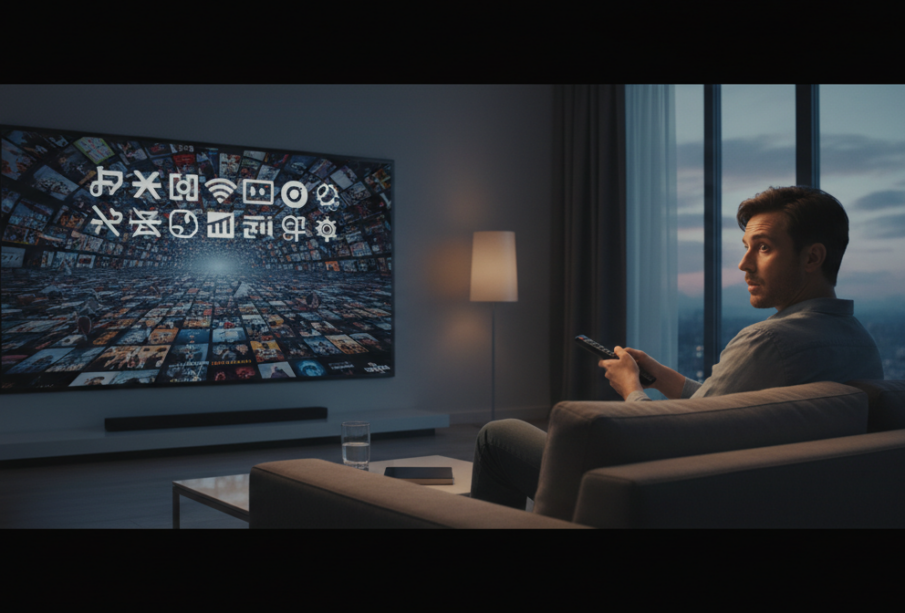
Americans spend nearly five full days each year just deciding what to watch. As streaming platforms multiply and choice paralysis grows, sophisticated algorithms are becoming the new gatekeepers of entertainment.
The Paradox of Endless Choice
Picture this: It’s Friday night, you’ve got your favorite snacks ready, and you’re settling in for a relaxing evening of streaming. Two hours later, you’re still scrolling through endless rows of content, no closer to finding something to watch than when you started. Sound familiar? You’re not alone. Recent data reveals that the average American spends 16 minutes daily just deciding what to watch – that’s nearly 110 hours per year, or roughly five full workdays spent in digital limbo.
This phenomenon, dubbed ‘choice fatigue,’ has become the streaming industry’s dirty little secret. What was supposed to liberate us from the tyranny of scheduled television has instead trapped us in an endless maze of options. The numbers are staggering: nearly three-quarters of viewers spend at least 15 minutes selecting content, while a quarter burn through 30 minutes or more. Some unfortunate souls report spending over 45 minutes browsing – longer than many TV episodes themselves.
The irony is palpable. We have access to more entertainment than any generation in human history, yet we’re increasingly paralyzed by the sheer volume of choices. It’s like standing in front of the world’s largest buffet and starving because you can’t decide what to eat first.
The Algorithm Revolution
Enter the recommendation algorithm – the invisible hand guiding your viewing experience. These sophisticated systems have become the unsung heroes of modern entertainment, processing millions of data points to predict what you might enjoy next. Netflix alone processes over one million events per second, analyzing every play, pause, fast-forward, and browse action in real time.
The technology behind these recommendations is remarkably complex. Modern algorithms employ a hybrid approach, combining collaborative filtering (analyzing users with similar tastes), content-based filtering (examining the attributes of shows and movies themselves), and knowledge-based systems that factor in contextual information like time of day and viewing device. It’s like having a friend who knows your taste perfectly, never sleeps, and has watched everything ever made.
The financial stakes are enormous. Netflix‘s personalization algorithms reportedly save the company over $1 billion annually by reducing subscriber churn. When 80% of content watched on the platform comes from algorithmic recommendations rather than browsing or searching, these systems aren’t just helpful features – they’re the primary way hundreds of millions of users discover their next obsession.
The Growing Fatigue
But even as algorithms become more sophisticated, viewer fatigue continues to mount. The streaming landscape has exploded from a handful of services to nearly 40,000 distinct channels across various platforms globally. The U.S. accounts for nearly 80% of these channels, creating a content ecosystem so vast it defies human comprehension.
Subscription fatigue is real and measurable. Recent surveys show that 42% of American subscribers feel they have too many streaming subscriptions, with nearly half planning to cancel at least one service within the next year. The average household now pays for four streaming services, spending around $61 monthly – a figure that’s increased dramatically from just $48 a few years ago.
The psychological toll is becoming apparent. About 28% of Americans report spending less on streaming due to what researchers call ‘stream fatigue’ – the overwhelming feeling of having too many apps and too many choices. It’s a peculiar modern ailment: being stressed by having too much entertainment.
The Search for Solutions
The industry is scrambling to address these challenges. Some platforms are experimenting with more aggressive curation, while others are investing heavily in AI-powered recommendation engines that promise to cut through the noise. Kinobox, for instance, has introduced what it claims is the world’s first AI-powered movie rating system, analyzing factors like cast, director, and real-time buzz to predict a film’s potential reception.
Meanwhile, viewers are voting with their wallets. Ad-supported streaming services are gaining traction as cost-conscious consumers seek alternatives to expensive subscription stacks. Over half of U.S. viewers now regularly watch ad-supported content, with many willing to tolerate commercials in exchange for free access.
The rise of ‘FAST’ (Free Ad-Supported Streaming Television) channels represents a return to a more curated, traditional television experience – albeit delivered through modern streaming infrastructure. It’s television’s equivalent of comfort food: familiar, predictable, and requiring minimal decision-making.
The Future of Choice
As we look ahead, the streaming wars are evolving from a battle for content to a fight for attention and simplicity. The platforms that succeed will be those that can deliver the right content at the right moment without overwhelming their users. This means smarter algorithms, better interfaces, and perhaps most importantly, the wisdom to know when less is more.
The ultimate irony of our streaming age may be that in our quest for infinite choice, we’re discovering the value of intelligent curation. The future of entertainment might not be about having access to everything, but about having the right thing suggested at exactly the right moment. After all, the best recommendation isn’t necessarily the most accurate – it’s the one that gets you watching instead of scrolling.
As one industry analyst put it, we’re not just competing for viewers’ money anymore; we’re competing for their time and attention in an increasingly cluttered digital landscape. The winners will be those who can turn the overwhelming into the effortless, transforming choice paralysis into viewing pleasure.




Leave a reply



We bring you daily news from around the world. From technology to lifestyle to design and music.