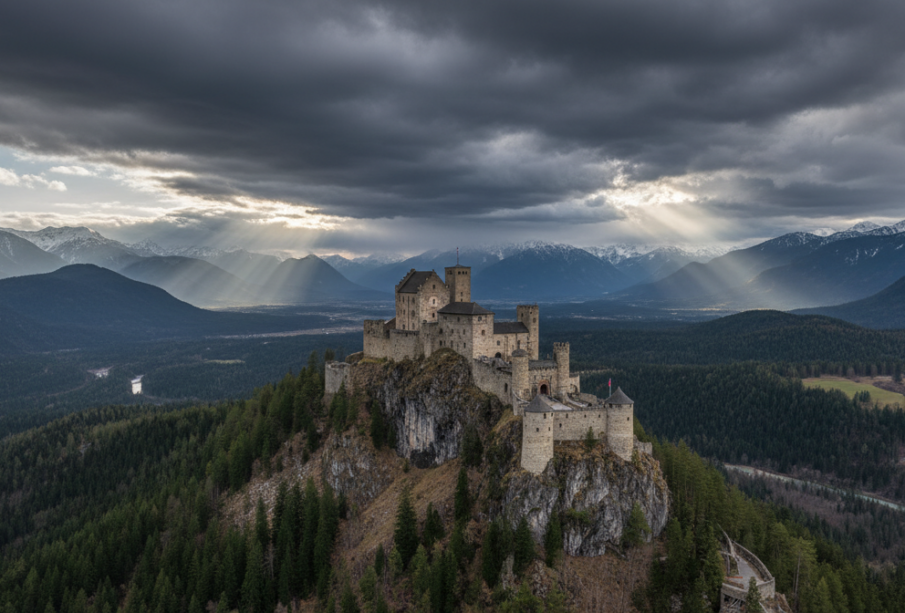
In the dying days of World War II, an unlikely alliance formed at an Austrian castle where American soldiers, German Wehrmacht troops, and French prisoners united against SS forces in one of history’s most bizarre battles.
A Medieval Castle Becomes a Nazi Prison
High in the Austrian Alps, about 12 miles west of Kitzbühel, sits Castle Itter – a medieval fortress that would become the stage for one of World War II’s most extraordinary battles. In February 1943, the Nazis seized this 13th-century castle and transformed it into something unprecedented: a luxury prison for high-value French captives.
Unlike the horrors of other Nazi camps, Castle Itter operated more like a gilded cage. The prisoners – former French Prime Ministers Édouard Daladier and Paul Reynaud, generals Maxime Weygand and Maurice Gamelin, tennis champion Jean Borotra, and even Charles de Gaulle’s sister Marie-Agnès – lived in converted hotel rooms. They could access the castle library, stroll the courtyard, and were fed adequately. Some even had hidden radios to listen to BBC broadcasts.
When the Guards Fled
By early May 1945, the Third Reich was collapsing. Hitler had committed suicide on April 30th, and Allied forces were closing in from all directions. At Castle Itter, panic set in among the SS guards.
On May 2nd, Eduard Weiter, the last commandant of Dachau concentration camp, arrived at the castle only to take his own life the same day. This sent a clear message to the remaining guards. By May 4th, SS commander Sebastian Wimmer and his wife had vanished, followed by all the guards. The French prisoners suddenly found themselves free – but trapped. Hostile SS units still roamed the surrounding mountains, and any encounter would likely mean execution.
An Unlikely Alliance Forms
Desperate for help, the prisoners sent Zvonimir Čučković, a Yugoslav handyman who had been working at the castle, to find Allied forces. Cycling through dangerous territory on a commandeered bicycle, he made contact with American troops from the 103rd Infantry Division near Innsbruck.
Meanwhile, the castle’s cook, Andreas Krobot, encountered Major Josef Gangl, a Wehrmacht officer who had already decided to surrender to the Americans. When Gangl learned about the French VIPs trapped at the castle, he knew they needed immediate rescue. He made contact with Captain Jack Lee Jr. of the 23rd Tank Battalion, 12th Armored Division.
What happened next defied all military logic: an American tank commander and a German major began planning a joint rescue mission.
The Battle Begins
On the afternoon of May 4th, 1945, an extraordinary force assembled at Castle Itter. Captain Lee arrived with his Sherman tank ‘Besotten Jenny,’ about a dozen American soldiers, and Major Gangl’s Wehrmacht troops. They were joined by Kurt-Siegfried Schrader, a former SS officer who had defected and was now helping organize the castle’s defense.
The French prisoners, rather than hiding as ordered, grabbed weapons from the castle armory and joined the fight. Former Prime Minister Reynaud wielded an MP-40 submachine gun, while tennis star Borotra prepared for what would become his most important match.
At dawn on May 5th – just two days before Germany’s official surrender – approximately 150 Waffen-SS troops led by Oberführer Georg Bochmann launched their assault on the castle.
Heroes and Sacrifice
The battle was fierce and desperate. The SS forces brought 88mm anti-tank guns and 20mm cannons, quickly targeting Lee’s Sherman tank. ‘Besotten Jenny’ was hit and destroyed, forcing the crew to scramble to safety as the tank burst into flames.
As ammunition ran low, tennis champion Borotra volunteered for an impossible mission. The 46-year-old athlete vaulted over the castle wall and sprinted through enemy lines to reach American reinforcements from the 142nd Infantry Regiment, dodging SS bullets with the agility that had once made him a Wimbledon champion.
Tragically, Major Gangl – the German officer who had risked everything to save the French prisoners – was killed by an SS sniper while trying to move former Prime Minister Reynaud to safety. He became the only defender to die in the battle, earning recognition as an Austrian national hero.
Victory and Legacy
At 4:00 PM on May 5th, American reinforcements arrived just as the defenders were running out of ammunition. The SS forces, now outnumbered and outgunned, fled into the surrounding forests. The battle was over, and all the French prisoners had survived.
Historian Stephen Harding, author of ‘The Last Battle,’ noted the profound implications: ‘If the SS had managed to get into the castle and kill all these French VIPs, the history of post-war France would have been radically different. These prisoners formulated the policies that carried France into the 21st Century.’
The Battle of Castle Itter remains unique in World War II history – the only recorded instance where American and German troops fought as allies. It occurred five days after Hitler’s suicide and just two days before Germany’s surrender, making it possibly the war’s final battle. In a conflict defined by rigid ideological lines, this strange alliance proved that even in war’s darkest hours, humanity could transcend hatred when faced with a common evil.




Leave a reply



We bring you daily news from around the world. From technology to lifestyle to design and music.