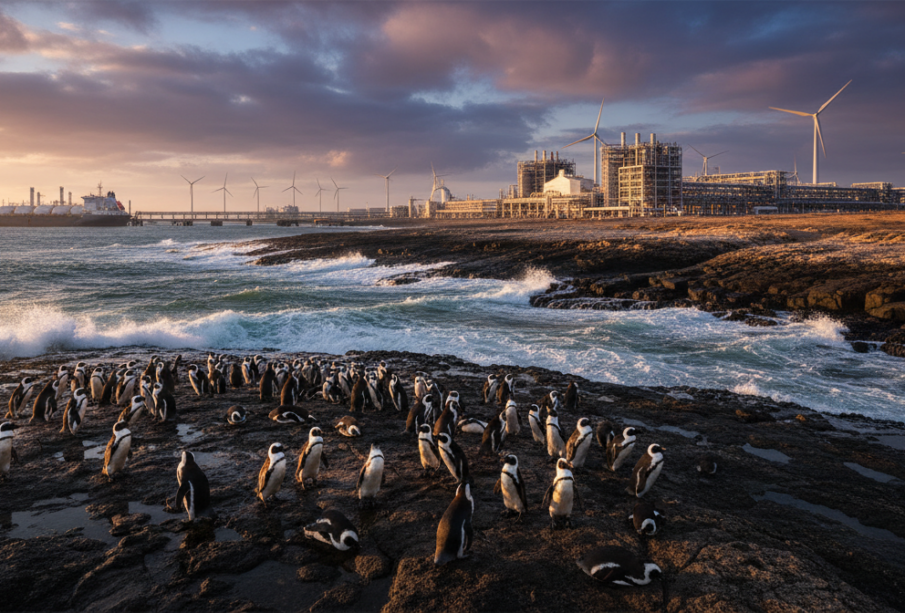
A massive $10 billion green hydrogen project in Namibia’s pristine national park is sparking fierce debate between economic opportunity and environmental protection.
The Desert’s Billion-Dollar Gamble
Picture this: a near-pristine desert wilderness that’s been virtually untouched for over a century, suddenly transformed into a massive industrial site. That’s the reality facing Tsau ǁKhaeb National Park in Namibia, where a $10 billion green hydrogen project is set to reshape both the landscape and the country’s economic future.
Hyphen, a joint venture between German renewable energy giant Enertrag and Nicholas Holdings, has been granted rights to develop what could become one of the world’s largest green hydrogen facilities. The numbers are staggering: 350,000 tons of green hydrogen annually when fully operational, potentially creating up to 80,000 jobs by 2030.
But here’s where it gets complicated. This isn’t just any patch of desert – it’s a biodiversity hotspot that environmentalists are calling irreplaceable.
The Penguin Problem
The timing couldn’t be worse for Namibia’s most famous tuxedo-wearing residents. African penguins have just been upgraded to ‘critically endangered’ status, with their population crashing by 97% from historical levels. Only about 1,200 breeding pairs remain in the Namibian Islands’ Marine Protected Area – a 250-mile stretch of coastline that’s supposed to be their safe haven.
Neil Shaw from the Namibian Foundation for the Conservation of Seabirds (NAMCOB) isn’t mincing words: ‘Where they plan to expand the port is a particularly bio-sensitive hotspot.’ The proposed port expansion in Lüderitz could disrupt the marine ecosystem these penguins desperately depend on.
It’s a cruel irony. These penguins are already fighting for survival against overfishing, climate change, and habitat loss. Now they face the prospect of their last refuge being industrialized in the name of fighting climate change.
Germany’s Green Colonialism?
Chris Brown from the Namibian Chamber of Environment isn’t pulling punches when he calls this ‘green colonialism.’ His argument is brutally simple: ‘The Germans would never allow their top parks to be turned into industrial sites, but they seem to be quite happy to offshore not only the risk, but also the impacts on biodiversity to Namibia.’
The park covers 10,000 square miles – larger than seven of Germany’s biggest protected areas combined. It hosts 25% of Namibia’s plant species in just 3% of the country’s land area, including 31 species found nowhere else on Earth. Some of these plants have evolved ingenious survival strategies over millennia, from water storage to light reflection.
Environmentalists have coined a new term for this project: ‘red hydrogen.’ The idea is that any hydrogen produced at the expense of biodiversity shouldn’t be called ‘green’ at all. It’s a clever bit of branding that cuts to the heart of the debate – can something truly be environmentally friendly if it destroys pristine ecosystems?
The Economic Reality Check
But let’s be real about the economics here. For a country with Namibia’s economic challenges, this project represents a potential game-changer. The $10 billion investment roughly equals the country’s entire annual GDP. By 2030, the hydrogen sector could add $6 billion to the economy – a 30% boost.
Phil Balhao, former mayor of Lüderitz, is already seeing changes: ‘We’re seeing new investments, new opportunities, new services and amenities that never would have come down to Lüderitz.’ For a sleepy fishing town that’s struggled economically, the promise of transformation is tantalizing.
Hyphen’s Toni Beukes argues they’re doing everything possible to minimize environmental impact while staying competitive globally. ‘The south is where you have a co-location of fantastic wind and solar resources. Namibia has to compete with other projects globally and that’s where your competitive advantage lies.’
The project is still in feasibility studies until late 2026, giving both sides time to make their case. But with the European Investment Bank already signaling support and Germany pushing hard for hydrogen imports, the momentum seems to be building toward approval.




Leave a reply



We bring you daily news from around the world. From technology to lifestyle to design and music.