The assassination of Ayatollah Ali Khamenei in joint US-Israeli strikes has unleashed a cascade of retaliatory attacks across the Gulf, effectively shuttering the world’s most critical oil chokepoint and sending energy markets into turmoil.
In my 25 years covering Wall Street’s energy markets, I’ve witnessed oil shocks from the Gulf War to the Arab Spring. But nothing quite compares to what unfolded this weekend when President Trump announced that Iran’s Supreme Leader Ayatollah Ali Khamenei had been killed in coordinated strikes by US and Israeli forces.
The 86-year-old ayatollah, who had ruled Iran with an iron fist for 36 years, died Saturday morning in what Israeli officials described as a ‘massive, wildly bold daytime attack’ on his compound in Tehran. Within hours, the geopolitical earthquake had triggered something far more immediate and economically devastating: the effective closure of the Strait of Hormuz.
This narrow waterway, just 21 miles wide at its narrowest point, handles roughly one-fifth of the world’s seaborne oil trade. By Sunday morning, it had become a maritime ghost town. While Iran hasn’t formally declared a blockade, the Islamic Revolutionary Guard Corps began broadcasting warnings to vessels that ‘no ship is allowed to pass the Strait of Hormuz.’ The message was received loud and clear.
‘Our ships will stay put for several days,’ a top executive at a major trading desk told Reuters, capturing the sentiment rippling through energy markets worldwide. Maersk, the world’s second-largest container shipping company, suspended all vessel crossings through the strait ‘until further notice.’ Even Greece’s shipping ministry advised vessels to avoid the entire region.
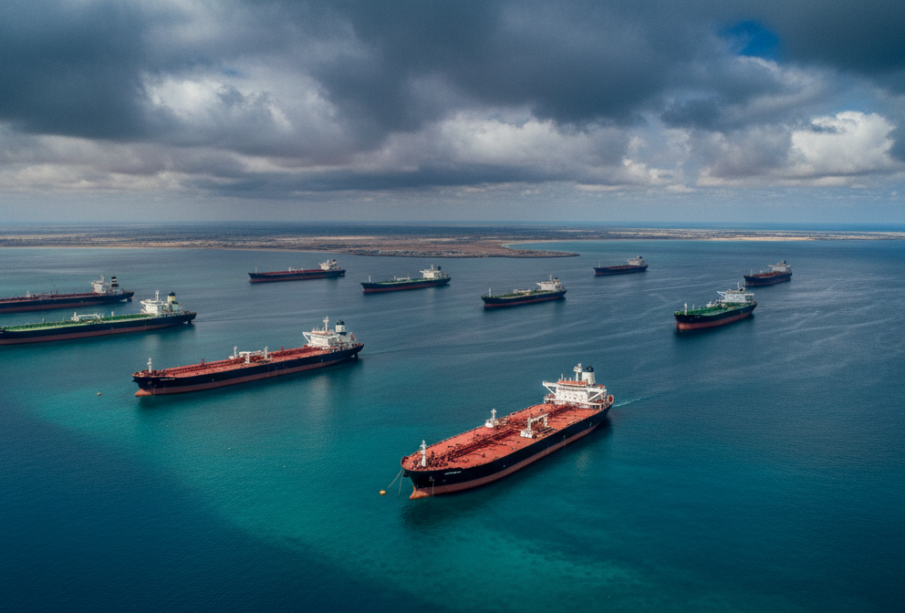
The numbers tell the story of a supply shock in real time. At least 150 tankers carrying crude oil and liquefied natural gas have dropped anchor in open Gulf waters, afraid to transit the chokepoint. Ship-tracking data shows a 70% reduction in traffic through the strait, with only Iranian and Chinese-flagged vessels continuing to move. Insurance premiums have spiked to six-year highs, making transit economically unviable for most operators.
Brent crude, which closed Friday at $73 per barrel, jumped 10% to around $80 in over-the-counter trading Sunday. But that’s likely just the beginning. Energy analysts are warning of prices potentially hitting $100 per barrel or higher if the disruption persists. ‘Closure of the Strait of Hormuz would disrupt roughly a fifth of globally traded oil overnight – and prices wouldn’t just spike, they would explode,’ Ali Vaez of the International Crisis Group told Al Jazeera.
The human cost has been equally staggering. Iran’s retaliatory strikes have killed at least three people in the UAE, 16 injured in Qatar, and one dead in Kuwait. Fresh explosions rocked Dubai, Doha, and Manama for a third consecutive day Monday, as Iranian missiles and drones targeted US military bases and civilian infrastructure across the Gulf.
The economic implications extend far beyond energy markets. Dubai’s Jebel Ali Port, one of the world’s busiest container hubs, was temporarily shuttered after debris from intercepted missiles sparked fires. Kuwait’s international airport suffered ‘significant damage’ to its runway. Even Saudi Arabia’s Ras Tanura refinery, which processes millions of barrels daily, was temporarily shut down after a drone attack.
What makes this crisis particularly dangerous is the lack of viable alternatives. Saudi Arabia’s East-West Pipeline can carry up to 7 million barrels per day to Red Sea ports, bypassing the strait entirely. The UAE has a similar pipeline to Fujairah. But combined, these alternatives can handle only about 17% of the strait’s normal traffic flow.
OPEC Plus has pledged to increase output by 206,000 barrels per day to mitigate shortages, but much of the group’s spare capacity – concentrated in Saudi Arabia and the UAE – can’t reach global markets if the strait remains inaccessible. It’s a cruel irony: the countries with the most spare oil capacity are the same ones now absorbing Iranian missile strikes.
The succession crisis in Iran adds another layer of uncertainty. With no designated successor to Khamenei, an interim Leadership Council has been established, but the country’s power structure remains in flux. Trump claimed that 48 Iranian leaders have been killed in the ongoing bombardments, leaving the regime’s command structure in tatters.
For global markets, the timing couldn’t be worse. The world economy was already grappling with persistent inflation and supply chain disruptions. Now, with approximately 20 million barrels per day of oil transit at risk, central banks face the nightmare scenario of energy-driven price spikes just as they were making progress on inflation.
The parallels to 1979 are impossible to ignore. Then, as now, geopolitical upheaval in the Gulf sent oil prices soaring and triggered a global recession. But today’s interconnected economy makes the potential impact even more severe. From airlines canceling flights across the Middle East to container ships rerouting around Africa’s Cape of Good Hope, the ripple effects are already visible.
As I write this, the situation continues to deteriorate. Iran’s armed forces have vowed their ‘biggest offensive’ against US bases and Israel. President Trump has warned of retaliation with ‘force that has never been seen before’ if Iran escalates further. The world’s most important oil chokepoint hangs in the balance, and with it, the stability of global energy markets.
In three and a half decades of covering financial markets, I’ve learned that geopolitical shocks often create opportunities alongside the chaos. But this feels different – more consequential, more dangerous. The death of Ali Khamenei may have ended an era of authoritarian rule in Iran, but it has also unleashed forces that could reshape global energy markets for years to come.


Leave a reply



We bring you daily news from around the world. From technology to lifestyle to design and music.