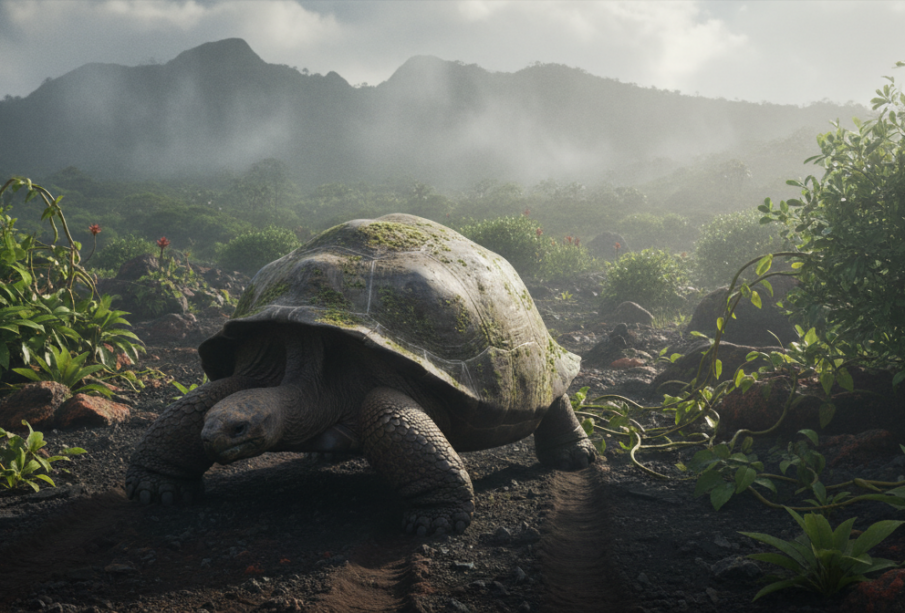
After nearly two centuries of absence, 158 giant tortoises have returned to Floreana Island in the Galápagos, marking one of the most ambitious ecological restoration efforts ever undertaken in the archipelago.
The scene on Floreana Island this February resembled something out of a conservation fairy tale. Nine men marched single file up volcanic slopes under the equatorial sun, carrying 100-pound plastic crates strapped to their backs. Inside those crates were passengers that hadn’t walked these landscapes for 180 years: giant tortoises returning home.
On February 20, 2026, Galápagos National Park rangers released 158 juvenile giant tortoises back to their ancestral habitat, marking the first successful reintroduction of the Floreana giant tortoise since the species vanished in the mid-1800s. The moment represents a milestone in what experts call one of the most ambitious ecological restoration projects ever attempted in the Galápagos Islands.
‘It’s a huge deal to have these tortoises back on this island,’ said James Gibbs, Vice President of Science and Conservation at Galápagos Conservancy. ‘Charles Darwin was one of the last people to see them there.’ The historical weight of that statement cannot be overstated – these creatures disappeared during Darwin’s lifetime, victims of relentless hunting by whalers and the devastating impact of invasive species.
The tortoises released range from 8 to 13 years old, carefully selected for their genetic makeup and size. At their current weight of several dozen pounds each, they’re large enough to defend themselves against introduced predators like rats and cats that still roam the 67-square-mile island. The timing of their release coincided perfectly with the arrival of the season’s first winter rains, providing optimal conditions for their reintegration.
What makes this story truly remarkable isn’t just the return itself, but the scientific detective work that made it possible. In 2000, researchers made an unexpected discovery on Wolf Volcano on Isabela Island – tortoises that didn’t belong there. Among the dome-shelled tortoises native to Isabela, they found saddleback-shelled specimens that looked suspiciously like the extinct Floreana species.
Genetic analysis later confirmed what seemed impossible: these were descendants of Floreana tortoises, likely transported there by 19th-century whalers who used the animals as living food storage. The discovery launched a breeding program that has since produced hundreds of offspring carrying between 40 and 80 percent of the original Floreana genetic makeup.
Claudio Cruz, a 66-year-old farmer on Floreana, watched the release with tears in his eyes. ‘It all makes me very emotional,’ he admitted, thinking about the ecological damage finally being undone. Cruz, one of 12 siblings who grew up on the island, calls Floreana ‘the capital of Galápagos’ and says the return of the giants means the island will now be complete.
The restoration effort extends far beyond just tortoises. Over the past decade, conservationists have worked to eliminate invasive species that made survival impossible for native wildlife. The results have been dramatic – crop yields for local farmers have increased by 80 percent since rat populations were controlled, and endemic bird species like the small ground finch are showing healthier population numbers.
The island’s approximately 160 residents will soon share their home with more tortoises than people, as the breeding program plans to release a total of 700 tortoises over the coming years. But unlike conflicts seen elsewhere, the relationship between Floreana’s farmers and wildlife runs deep. ‘When you look at a tortoise, into its eyes,’ Cruz explains, ‘they recognize you.’
NASA satellite data played a crucial role in determining optimal release sites, helping scientists identify areas where the animals could find food, water, and suitable nesting habitat. The space agency’s Earth observation technology answered a practical question that will determine the project’s long-term success: where will these animals have the best chance to survive not just today, but decades from now?
The broader implications of this success story extend throughout the Galápagos archipelago. Giant tortoises historically shaped these landscapes by grazing vegetation, opening pathways through dense plant growth, and carrying seeds between islands. Their absence from Floreana for nearly two centuries allowed invasive plant species to flourish and disrupted natural ecological processes.
This reintroduction represents the first of 12 locally extinct species planned for return to Floreana as part of the island’s comprehensive ecological restoration. The project, led by Ecuador’s Ministry of Environment through the Galápagos National Park Directorate, involves collaboration between multiple international conservation organizations and represents a new model for community-based restoration efforts.
For Gibbs, who first encountered the mysterious Wolf Volcano tortoises 26 years ago, the moment carries profound personal significance. ‘Some moments in conservation stay with you,’ he reflects. Standing on that volcanic slope in 2000, he couldn’t have imagined that his unexpected discovery would lead to this historic homecoming.
The released tortoises, equipped with tracking devices, will be monitored as they explore their ancestral habitat and begin the slow process of reshaping Floreana’s ecosystem. With lifespans exceeding a century, these animals represent not just a conservation success story, but a long-term investment in the island’s ecological future. Their return marks the beginning of a new chapter that will unfold over decades and centuries, as tortoises once again shape the landscapes of Floreana Island.



Leave a reply



We bring you daily news from around the world. From technology to lifestyle to design and music.