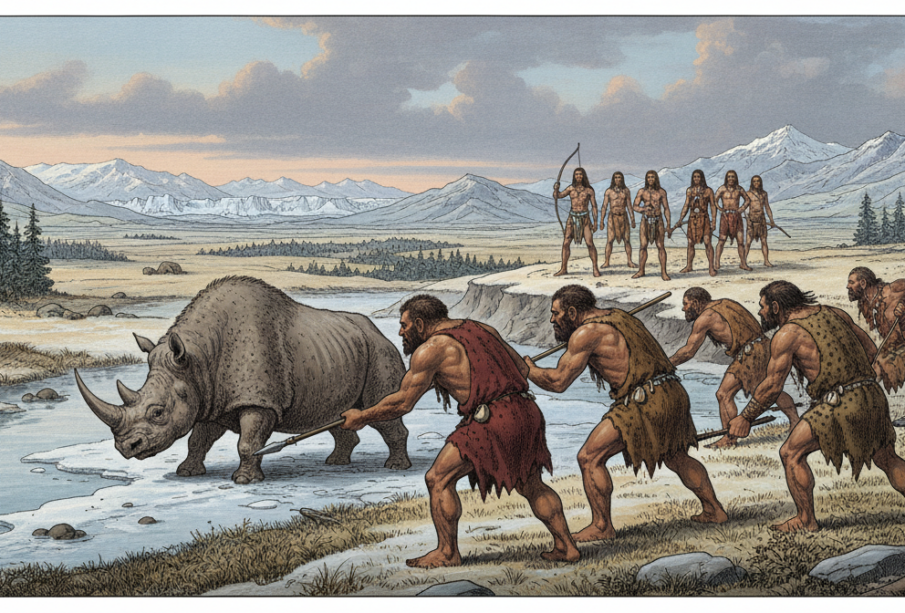
A groundbreaking study reveals that prehistoric romance between Neanderthal males and modern human females shaped the genetic blueprint of humanity, challenging decades of scientific assumptions about our evolutionary past.
The Mystery of the Missing DNA
For over two decades, geneticists have puzzled over a strange gap in the human genome. While most people of non-African descent carry about 1-2% Neanderthal DNA scattered throughout their chromosomes, the X chromosome tells a different story entirely.
This sex chromosome appears almost scrubbed clean of Neanderthal ancestry, containing what researchers call ‘Neanderthal deserts’ – vast stretches where our ancient cousins’ genetic contributions are virtually absent. Scientists long assumed these gaps resulted from natural selection weeding out harmful Neanderthal genes that caused health problems or fertility issues.
But a new study published in Science magazine has turned this conventional wisdom on its head, revealing a far more intriguing explanation rooted in ancient attraction rather than genetic incompatibility.
The Sex-Biased Discovery
Alexander Platt and Daniel Harris from University of Pennsylvania’s Tishkoff lab approached the mystery from an entirely new angle. Instead of just examining modern human genomes, they decided to look at the flip side of the equation – what happened to human DNA in Neanderthal genomes?
Their analysis of three Neanderthal specimens – Altai, Chagyrskaya, and Vindija – revealed a striking pattern. While modern humans lack Neanderthal DNA on their X chromosomes, Neanderthals showed a remarkable 62% excess of modern human DNA on their X chromosomes compared to other chromosomes.
‘What we found was a striking imbalance,’ Harris explained. This mirror-image pattern suggested something far more complex than simple genetic incompatibility was at work.
Ancient Romance Patterns
The key to understanding this genetic puzzle lies in how X chromosomes are inherited. Females carry two X chromosomes, while males have one X and one Y. Fathers can only pass their X chromosome to daughters, never sons, while mothers always pass an X chromosome to both daughters and sons.
This inheritance pattern means that when populations interbreed, the direction of mating matters enormously for the X chromosome pool. The research team’s findings point to a consistent pattern: Neanderthal males preferentially mated with modern human females, rather than the other way around.
‘We found a pattern indicating a sex bias: gene flow occurred predominantly between Neanderthal males and anatomically modern human females,’ Platt noted. This preference wasn’t just occasional – it was strong enough to leave a permanent signature in the human genome that persists 50,000 years later.
Beyond Biology: Social Attraction
The study challenges the long-held belief that human evolution was driven purely by survival of the fittest. Instead, it suggests that social interactions and mate preferences played a crucial role in shaping our genetic heritage.
The researchers ruled out biological explanations by examining whether the human DNA found in Neanderthal X chromosomes conferred any survival advantages. They discovered these sequences had lower-than-average concentrations of functional genetic elements, making a purely adaptive explanation less convincing.
‘Mating preferences provided the simplest explanation,’ Platt concluded. The findings suggest that when Neanderthal males encountered human females, some unknown factor made these pairings more attractive or desirable than other combinations.
Implications for Human History
This research opens new windows into understanding ancient human societies and migration patterns. The genetic evidence suggests that encounters between Neanderthals and modern humans weren’t random events but followed consistent social patterns that influenced which genes survived and which disappeared.
The study also hints at broader questions about Neanderthal social structure – who stayed in groups, who migrated, and how mate selection worked in prehistoric societies. By analyzing the ratio of X chromosome diversity to other chromosomes, researchers can begin to understand whether males or females were the primary dispersers between groups.
Josh Akey from Princeton University, who wasn’t involved in the study, noted that admixture between modern humans and Neanderthals was ‘a defining feature of hominin history.’ The research shows this mixing didn’t just give modern humans Neanderthal DNA – it fundamentally changed Neanderthals as well.
The Genetic Legacy Lives On
Today, the consequences of these ancient romantic preferences are written into the DNA of billions of people. Neanderthal genes continue to influence modern human health, affecting everything from circadian rhythms and immune system function to pain sensitivity.
The X chromosome’s unique evolutionary history means it carries particularly important information about our species’ past. As Tishkoff noted, roughly 600,000 years ago, the ancestors of modern humans and Neanderthals diverged into separate groups. But that separation was far from permanent.
Over hundreds of millennia, human populations migrated into Neanderthal territories and back again. When these groups met, they didn’t just compete for resources – they formed relationships, swapped DNA, and created the genetic foundation for modern humanity. The genome, when read carefully enough, reveals not just biological history but something closer to a social record of who approached whom, whose children stayed, and whose left – traces that remain legible in our DNA today.



Leave a reply



We bring you daily news from around the world. From technology to lifestyle to design and music.