Ancient Factory Rewrites Roman Britain’s Industrial Story
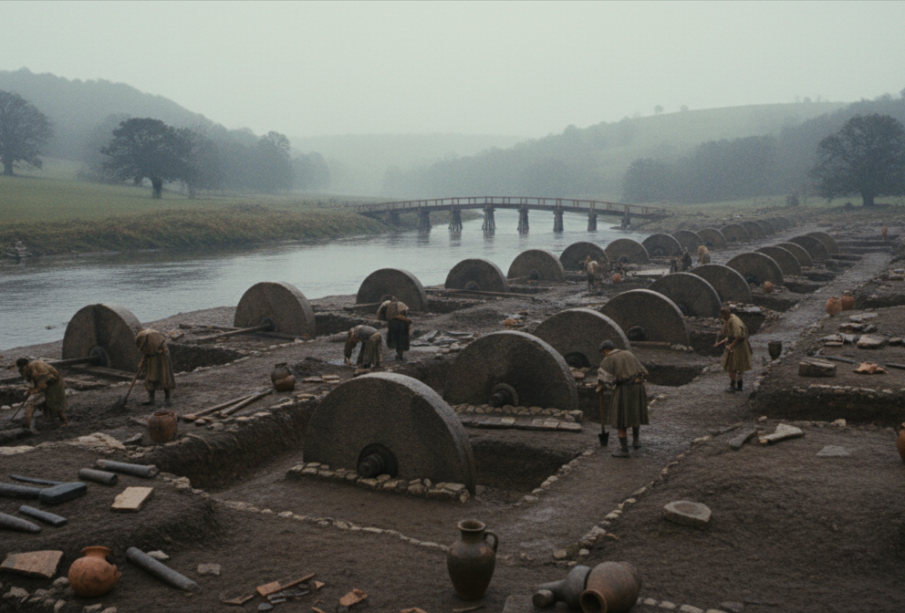
Archaeologists have uncovered the largest Roman whetstone production site in northwest Europe, revealing an unexpected industrial powerhouse along England’s River Wear.
Hidden in Plain Sight
For centuries, the muddy banks of the River Wear near Sunderland kept their secrets buried. “The academic consensus held that the Romans had never reached this part of the River Wear,” explains Gary Bankhead from Durham University. That belief just got shattered. Volunteers from the local Vedra Hylton Community Association, working alongside university archaeologists, have pulled over 800 whetstones and 11 stone anchors from the riverbank at Offerton. It’s “the largest known whetstone find of the period in North West Europe.”
More Than Just Sharpening Stones
These weren’t random tools scattered by time. The whetstones tell a story of massive industrial production. “Every craft — metalworking, carpentry, leatherworking, agriculture, shipbuilding, and even domestic food preparation — relied on sharp tools. Without whetstones, Roman tools simply wouldn’t function properly. They were as fundamental to daily life as chargers or batteries are today.” The site operated between 42 and 238 AD, confirmed through advanced dating techniques. Workers here weren’t just making a few tools for local use. The recorded whetstones are all damaged and were likely discarded during production as they no longer met the required length. Quality control was strict.
Industrial Scale Operation
The numbers are staggering. Alongside the 800 whetstones excavated, the team believe that there are hundreds, possibly thousands, more that remain buried within the riverbank. This wasn’t a small workshop. The team also found 65 ‘doubles’ – whetstones still conjoined prior to splitting – along with a rare ‘treble’. The stone anchors suggest a sophisticated transport network. The team believe the anchors could have been used by river going vessels transporting slabs of sandstone across the river for whetstone preparation. Raw materials came from one side of the river, finished products shipped out from the other.
Rewriting History
This discovery changes everything we thought we knew about Roman Britain’s northern frontier. The results suggest Offerton is the first Roman site found in Britain where stone was deliberately quarried for whetstone production. Just ten miles from Hadrian’s Wall, this industrial complex operated in what historians considered Roman Britain’s wild frontier. “Offerton presents several unusual features that don’t neatly fit the standard pattern of Roman industrial sites. The biggest challenge is reconciling the scale of activity with the absence of any known Roman settlement or fort directly adjacent to the site…yet no obvious Roman buildings or permanent structures nearby.”
What Comes Next
The River Wear isn’t done revealing its secrets. The site holds “enormous research potential.” “The industrial activity we’ve uncovered is so substantial that it almost certainly formed part of a wider system — one that may still be waiting to be discovered.” The excavation also turned up artifacts from much later periods, including cannonballs from the English Civil War. Collectively, these discoveries could extend the known timeline of human activity along this part of the River Wear by over 1,800 years. Sometimes the most important discoveries happen right under our feet, waiting for curious volunteers and patient archaeologists to uncover them.


Leave a reply



We bring you daily news from around the world. From technology to lifestyle to design and music.